
The Journey of the Stonewall Brigade Band
A narrative of resilience, tradition, and the enduring spirit of our community band.

Origins
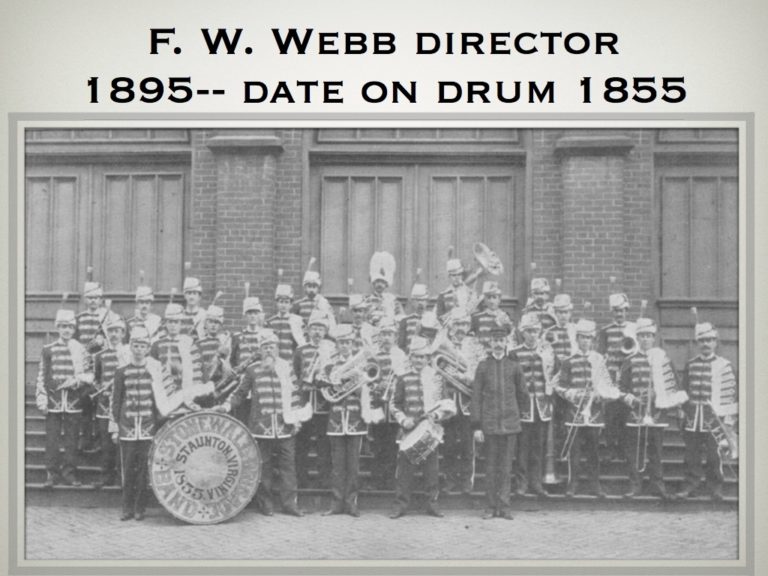
The Stonewall Brigade Band had its beginnings as the "Mountain Saxhorn Band" early in 1855.
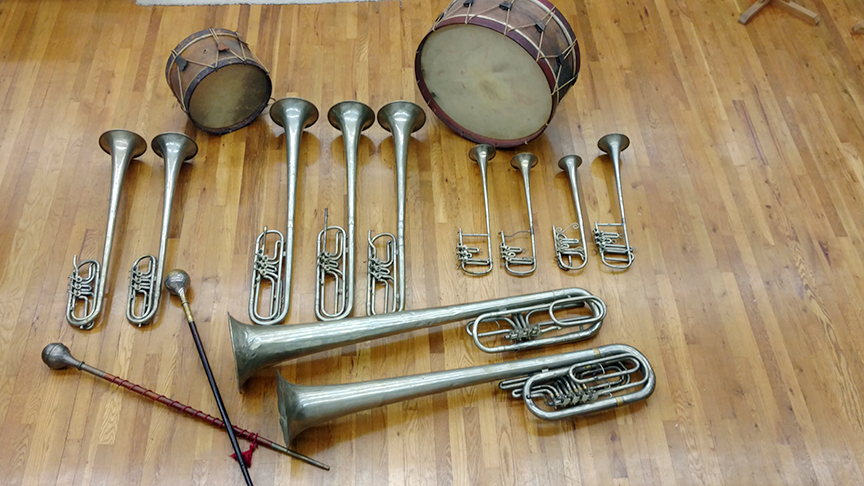
With the popularity of the Saxhorn, which had been patented by Antoine Adolphe Sax in 1845, and with the location of Staunton halfway across the Shenandoah Valley between the Blue Ridge and the Alleghany Mountains, it was natural for the group to adopt the name of Mountain Sax Horn Band. While the first president of the band was Edwin M. Cushing, it was David W. Drake, the founder, who secured the band's first director.
Both Drake and Cushing were in their early twenties and enlisted other young businessmen in the newly-formed band. Mr. Drake had been a pupil of Professor Augustus J. Turner, a music teacher in Newtown, located just south of Winchester, Virginia.
Mr. Drake prevailed upon Professor Turner to move to Staunton, where he became instructor of music in the Wesleyan Female Collegiate Institute.
The Early Years
Within six months of Professor Turner's arrival, the band had furnished music for the dedication of the Odd Fellows Hall, had held several concerts jointly with Professor Graham's band of the Deaf, Dumb and Blind Institute, and by 1857 had begun to travel. On Independence Day, 1857 the band went by train to Craigsville Depot to play a concert and two days later played for United States Senator R.M.T. Hunter, who was visiting in Staunton. The first formal public concert of the newly organized band took place on Friday Night, July 17, 1857 at Union Hall on Beverley Street in Staunton. Assisted by the Staunton Quartette and the Glee Club, the band played before an audience described as "the elite and fashionable of Staunton." The program included solos by Professor Alby; a burlesque, Teetotal Society, by Professor Turner; and a rendition of Turner's own composition, Gallopade. The admission charge was fifty cents per person or one dollar to any gentlemen accompanying one or more ladies.
Early Concerts
During the 1850's the band began a long-standing tradition of playing for all civic occasions and political rallies such as those held for President Fillmore, President Pierce, Presidential candidates Stephen A. Douglas and John C. Breckinridge, and the ardent secessionist William L. Yancey. The band headed all political processions regardless of party affiliation. All churches were accorded its services. During June 1858, it presented concerts twice in Union Hall, one for the Methodist ladies, who were holding a fair, and again for the Presbyterian ladies, who were conducting a similar fete. In March 1859, when the two rival candidates for Governor, William L. Goggin and John Letcher, were staying at the Virginia Hotel, the bandsmen serenaded both.
The Civil War
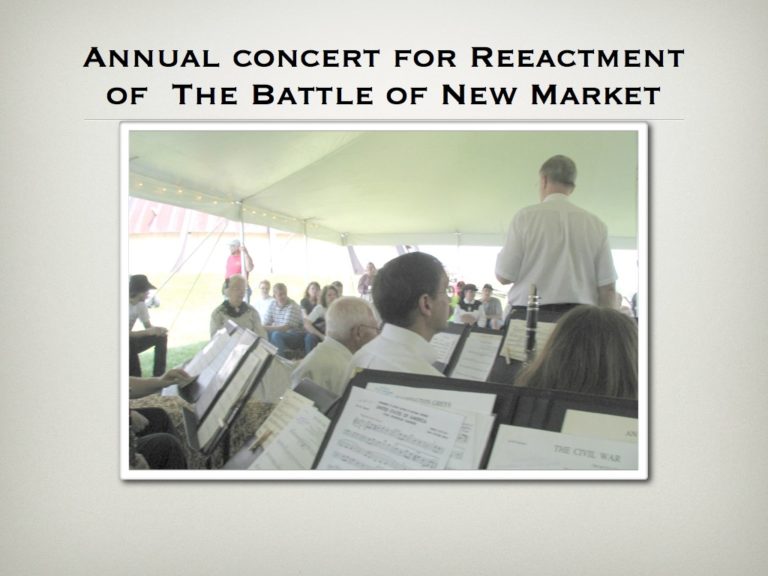
On Wednesday, April 17, 1861 Captain John D. Imboden, commander of the Staunton Artillery, was speeding westward from Richmond by special train. En route he received a telegram announcing that the Virginia Convention had passed the Ordinance of Secession. Imboden, anticipating the outcome of the issue, was hurrying with secret orders to move the Staunton military units as soon as he received official word. With the outbreak of the Civil War town bands (north and south) marched off with local battalions. The Augusta Guards became Company L of the Fifth Virginia Volunteer Infantry Regiment. With it most of the Mountain Saxhorn Band also mustered into General Thomas J. Jackson's First Brigade, Army of the Shenandoah. Of these band musicians who served during the war, one was killed, several were wounded, and one and probably one other were taken prisoner.
Throughout the conflict, the bandsmen performed a number of combat-related tasks, including guard and courier duties. From early 1862, they served as stretcher-bearers and surgeons' assistants. In addition to entertaining the troops in the field, they frequently appeared in concerts in Fredericksburg, Richmond, Staunton, and elsewhere to help recruiting rallies, clothing drives, and war relief fund raising.

A Happy Legend
Soon after Christmas in 1862, the members of the Fifth Virginia Volunteer Infantry (Stonewall Brigade) were detailed for picket duty along the Rappahannock River, below Fredericksburg, Virginia. The band exchanged serenades on several evenings with the Union band across the river. This was a time of quietude and good will; gifts of tobacco and apples were sent across the river while presents of coffee and candy were dispatched in return. Much later in the war, the long-awaited spring campaign began to open in the Wilderness of northern Virginia May 5, 1864. The Fifth Regiment, near Locust Grove, advanced far enough to the north to hear the strains of "The Star-Spangled Banner" played by one of Ulysses S. Grant's bands. The Stonewall Brigade Band responded with "The Bonnie Blue Flag" and the serenade was concluded with the Federal rendition of "Home, Sweet Home." In the years after the war, the true story of how the band members kept their instruments after the surrender gradually evolved through retelling and elaboration into a rather interesting legend which persisted throughout the twentieth century. The aging, war veteran members grew a story that it was a result of General Grant's awareness of the Fredericksburg Christmas event and that he responded with a personal order that allowed the Stonewall Brigade Band to retain possession of the only complete, unbroken set of Confederate Band instruments in existence – Saxhorns, invented by Antoine Sax of Brussels, Belgium. In fact, General Grant was not at Fredericksburg to hear the Christmas serenade and was not at Appomattox at the actual surrender ceremonies to issue such an order. Subsequent research reveals no such directive was ordered. In all likelihood the instruments remained with the members because they actually were their personal possessions and, fortunately, were considered by the Union to be personal possessions and not arms or other material of consequence to the terms of the surrender. Nevertheless, the "story" persisted and it influenced the band also to "grow" a particular affection for General Grant. When President Ulysses S. Grant stopped in Staunton on June 30, 1874 on his way by train to White Sulfur, West Virginia, the Staunton townspeople, and particularly, the band greeted him with fond enthusiasm. The band played several musical selections in tribute to the President from the portico of the American Hotel across from the Staunton depot. "...in response to an inquiry, Mayor Trout identified the musicians as members of the Stonewall Brigade Band. Grant, raising his hat and bowing, murmured, "The immortal Jackson!" Such only reinforced the fable that Grant had singled out the Stonewall Brigade Band for special treatment and the band went on to honor the man by playing for his funeral service in New York in 1885 and again for the dedication of his tomb. Albeit an untrue story, its prestige served the band well in subsequent years when many financial and structural organizational woes bedeviled the band. The band's rich heritage, this myth, and the character of the membership bolstered spirits to overcome many serious threats to the band's continuous existence.

Late Nineteenth Century
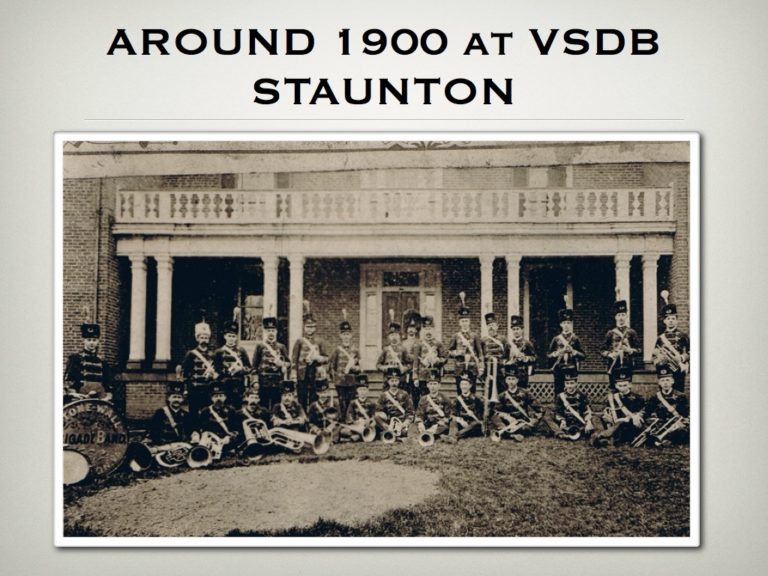
By 1875 the band was formally known as "The Stonewall Brigade Band”. The band included ten Civil War veterans and eight of the original founders of the band and. Edwin M. Cushing had continued as president of the band from the earliest years.
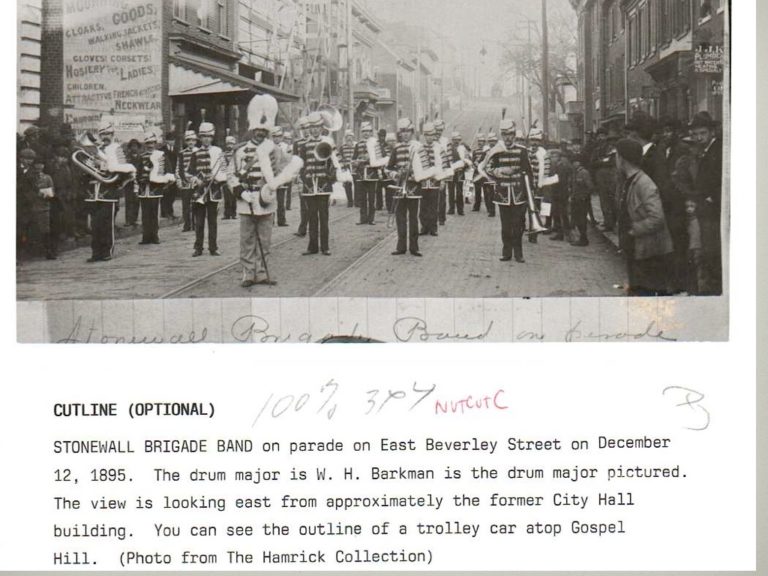
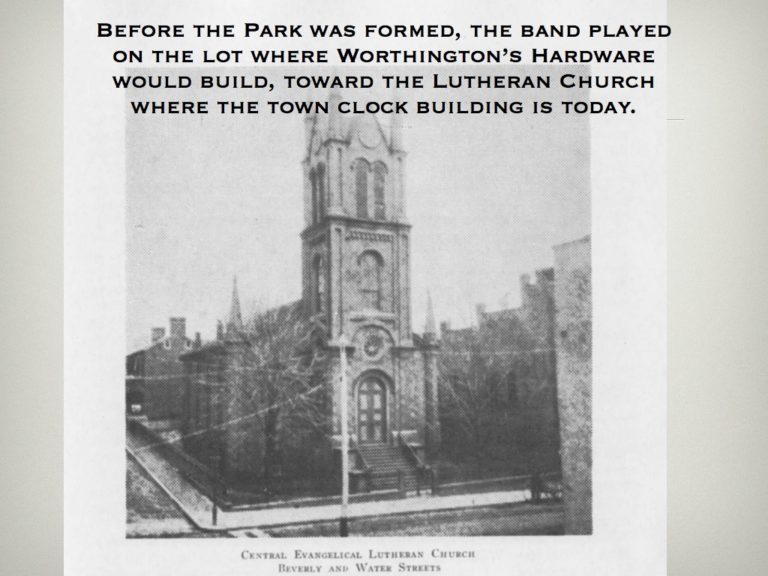
Before and soon after the Civil War, the band played concerts on the street corner of Main and Water Streets above the bridge (now called Beverley and Central Avenue), in the courthouse square, once on Reservoir Hill, and on West Main Street opposite Trinity Church.
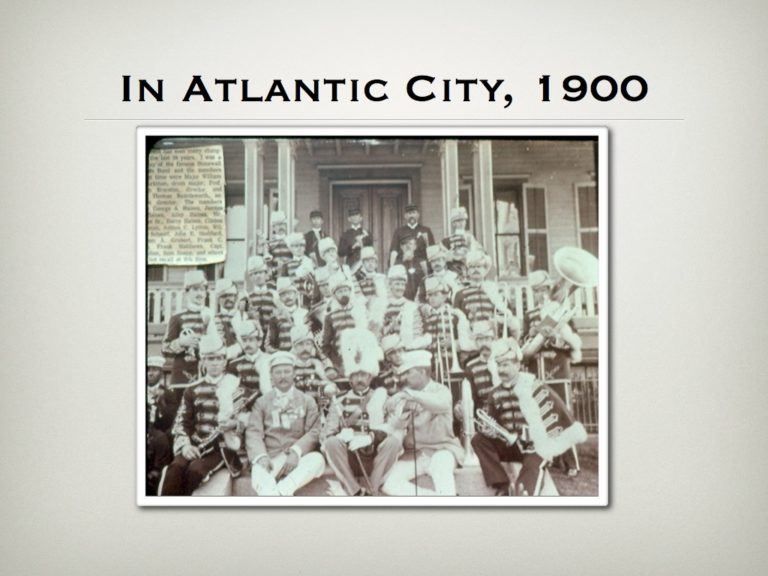
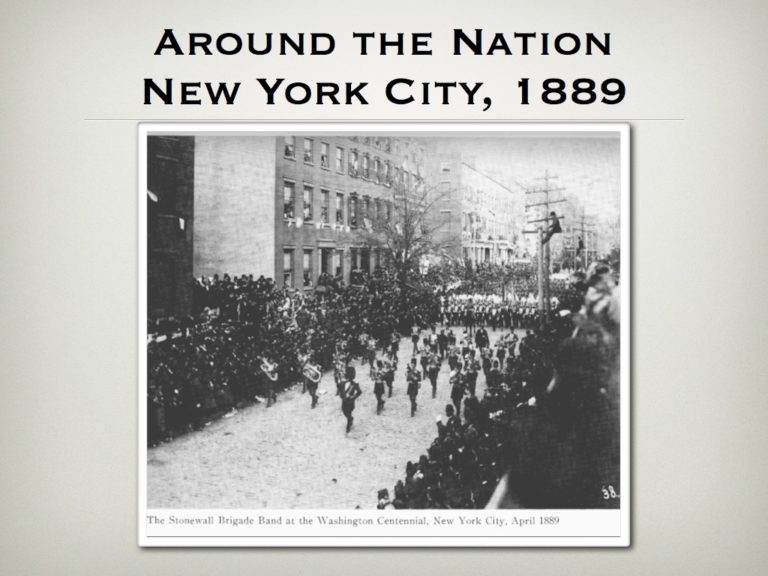
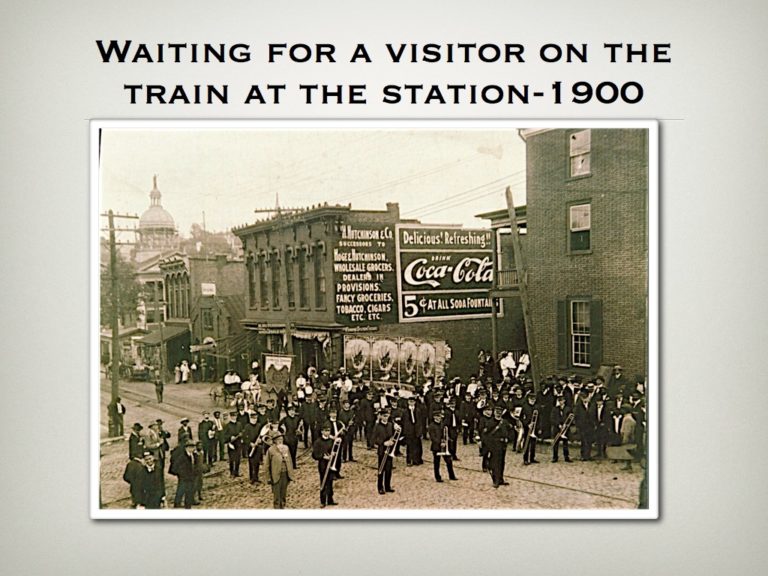
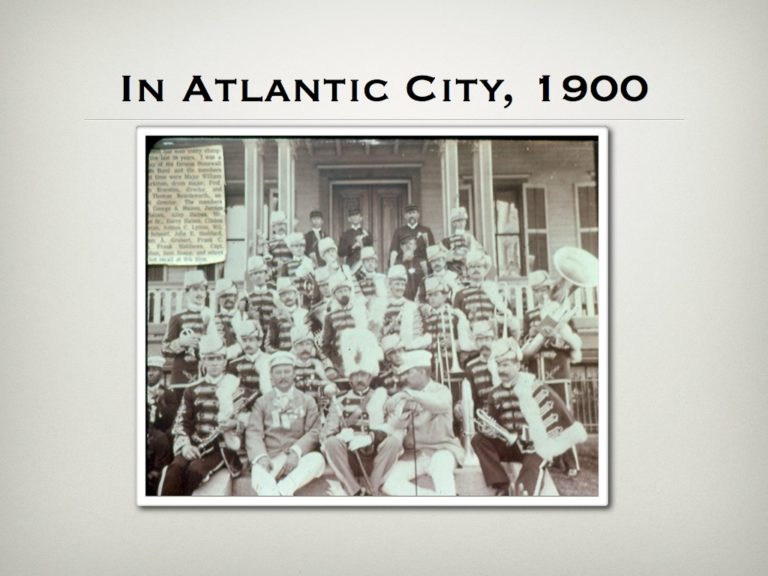
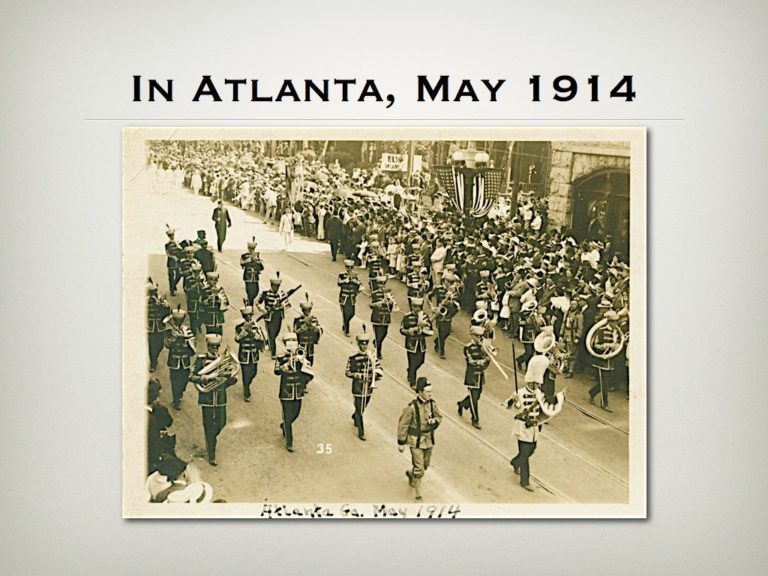
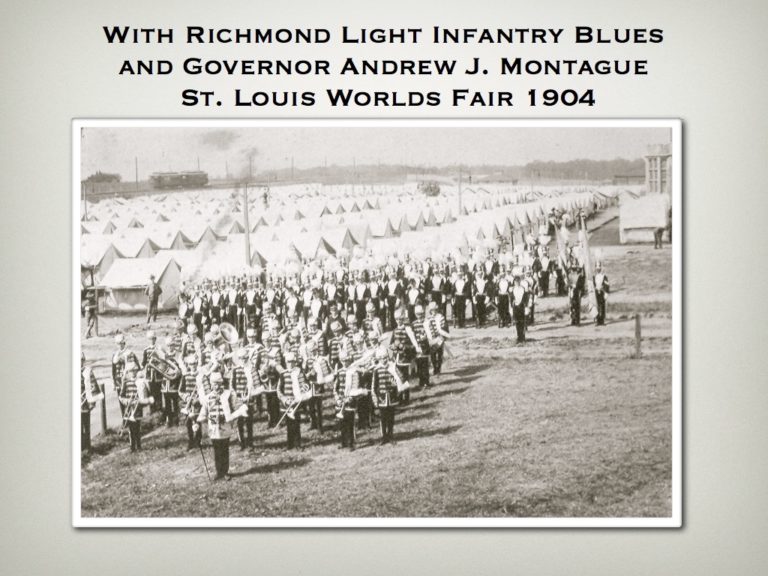
During the late-nineteenth and early-twentieth centuries the band became known nationally. In April 1889 the band went to the Washington Centennial in New York City and engaged in numerous parades and concerts.
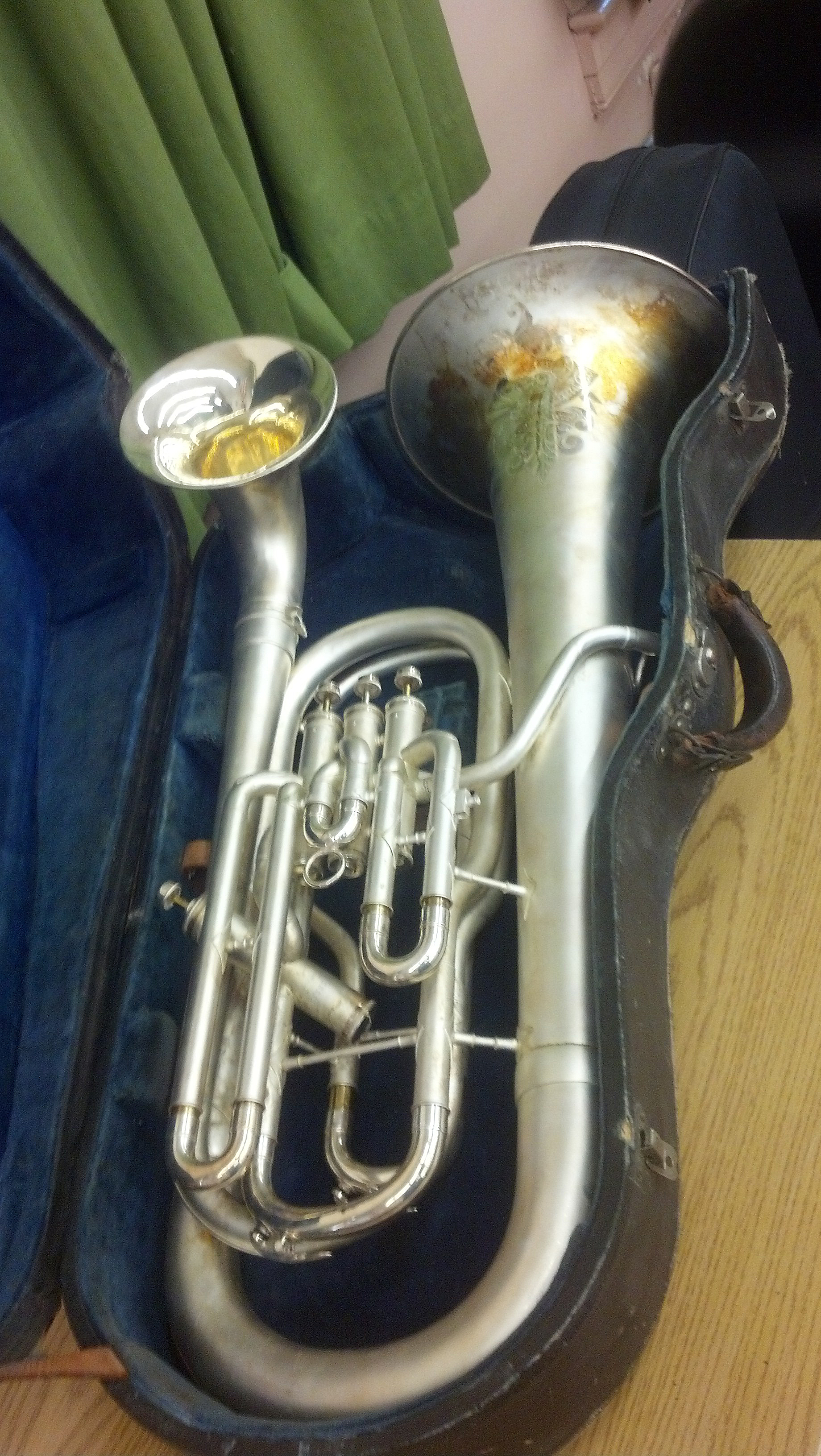
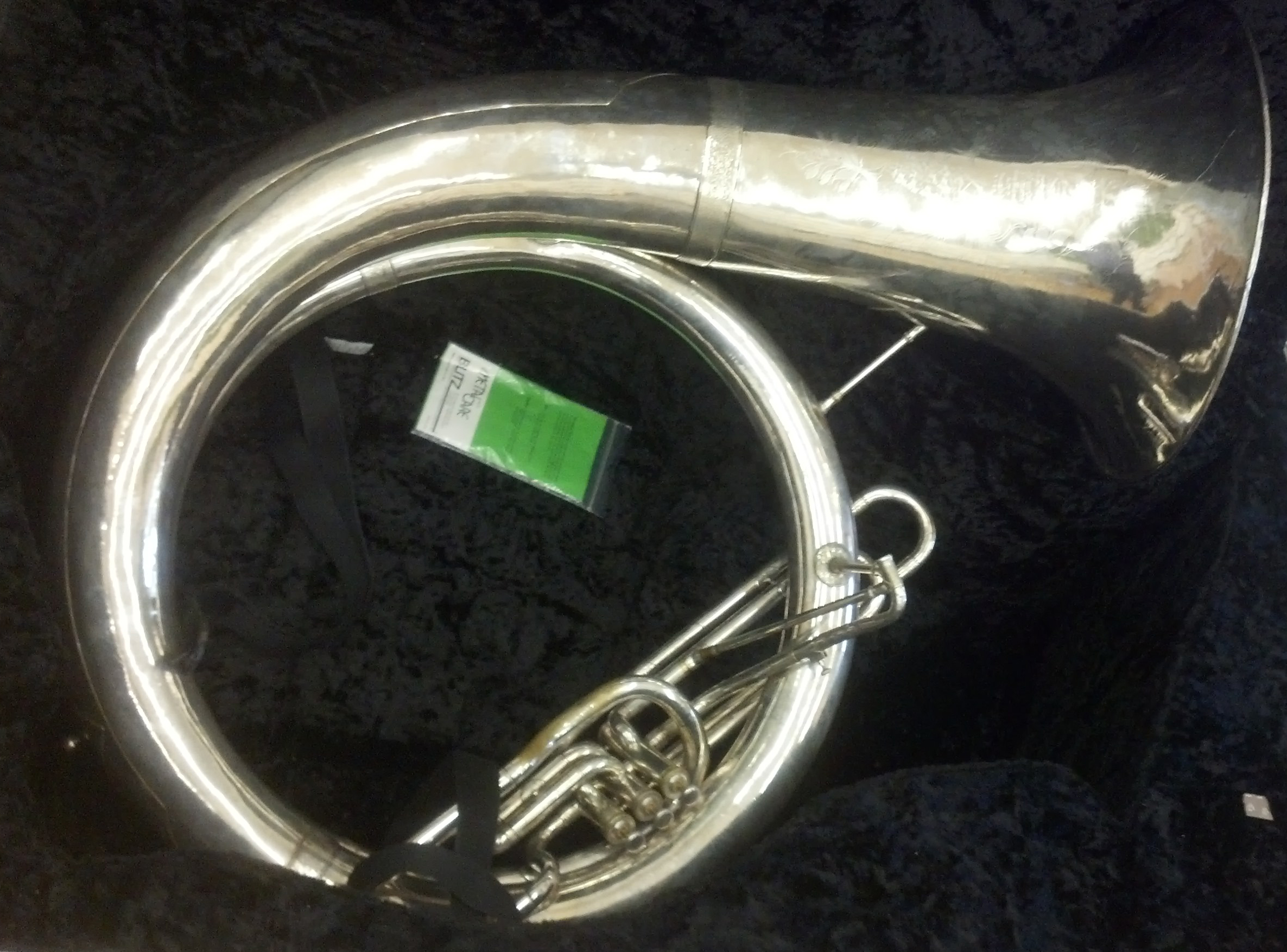
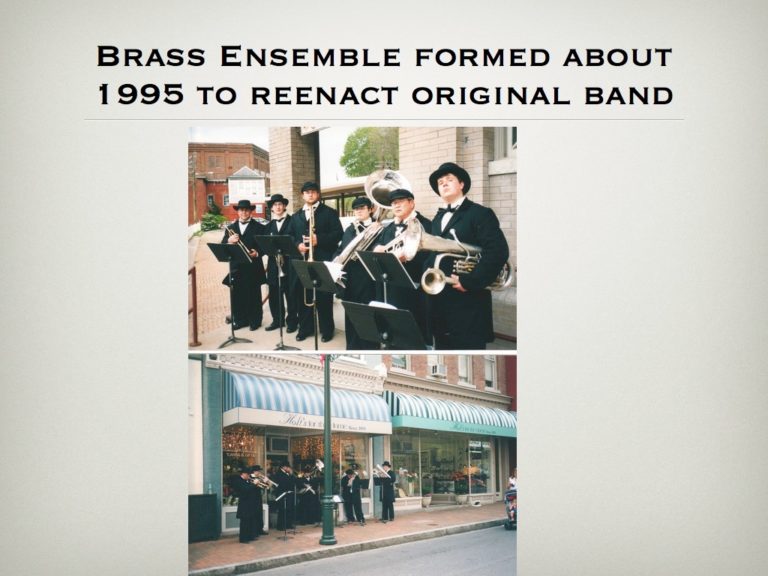
Here the band played for President Harrison and ex-President Cleveland. In 1893 the band was engaged for a two-week period at the Columbian Exposition, World's Fair, Chicago, where the band acquired the first-ever manufactured over the shoulder bass horn, called a helicon. This was the precursor of the famed Sousaphone. The Helicon is still in the band's possession and is used by the brass ensemble for performances of period music.

Inaugural Parades
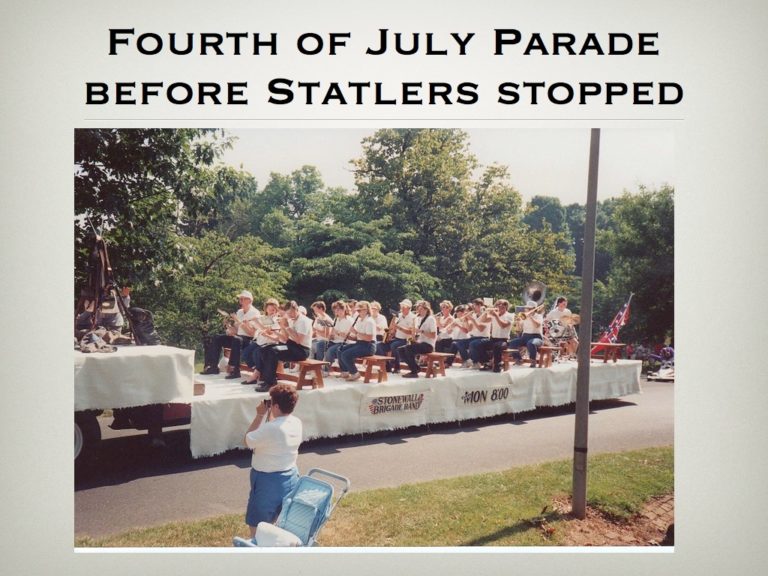
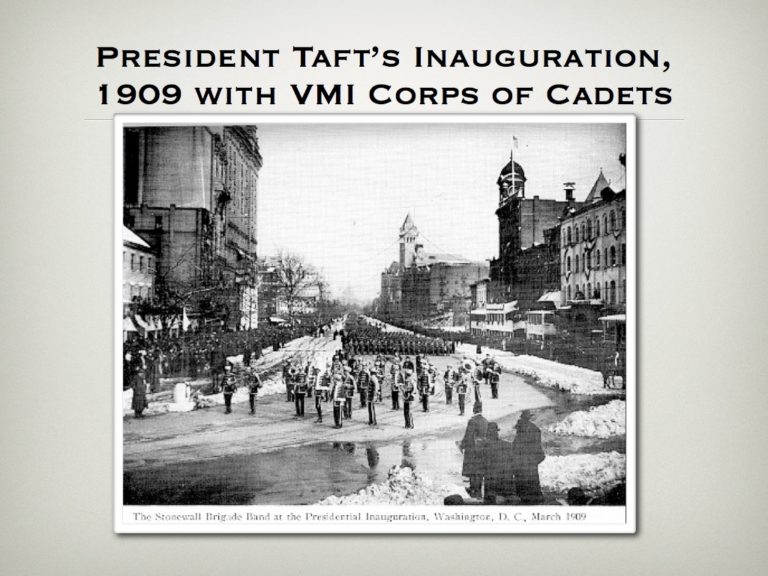
The band also marched in six Presidential Inaugural Parades (Taft's, McKinley's, and two each of Cleveland's and Wilson's) and played at Cleveland's Inaugural.
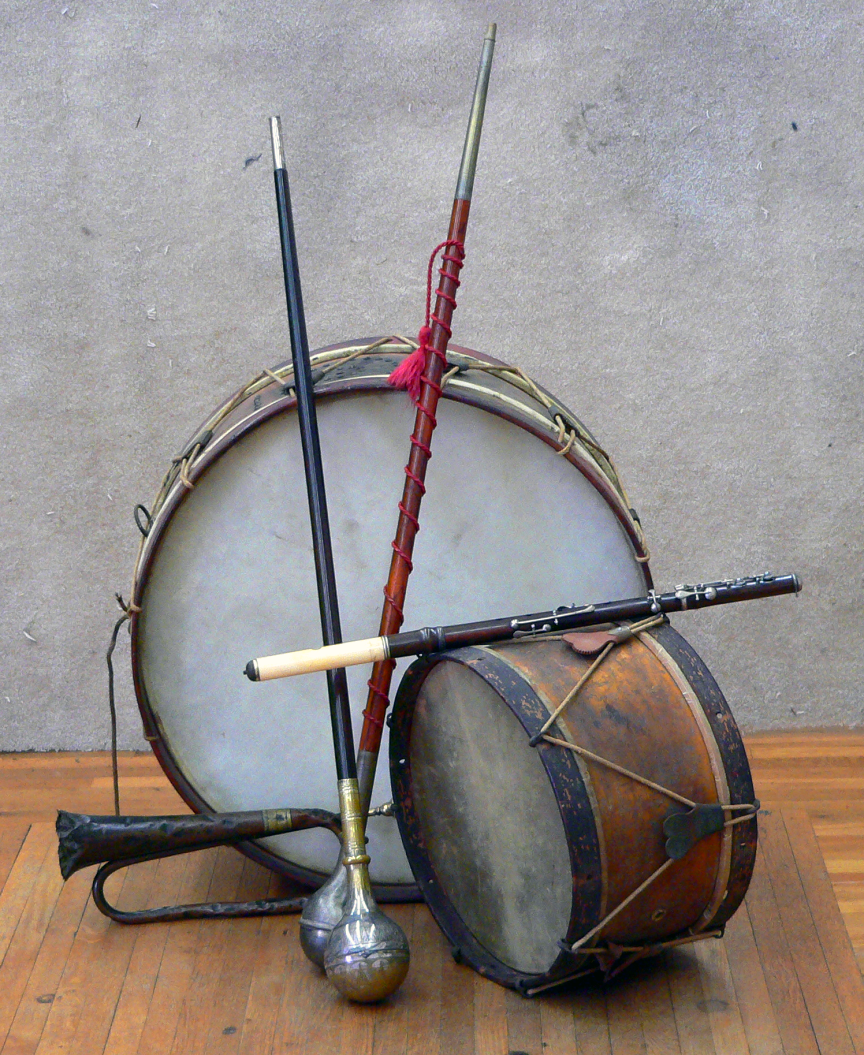
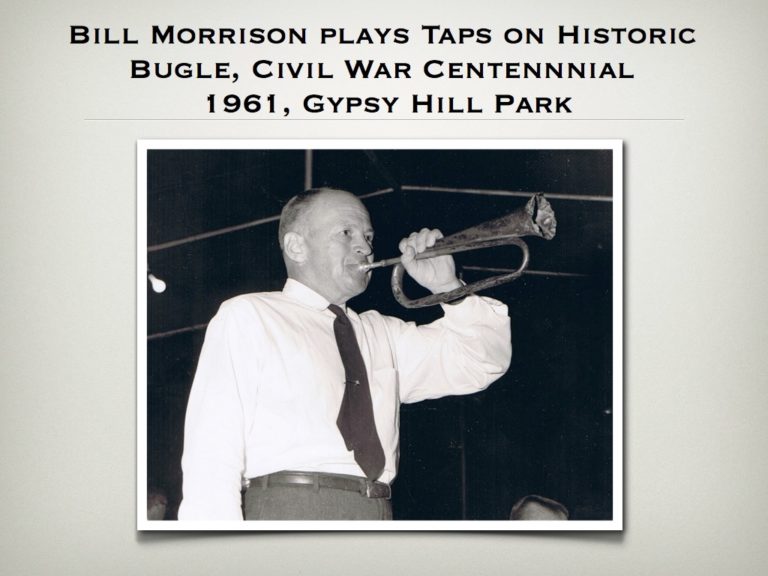
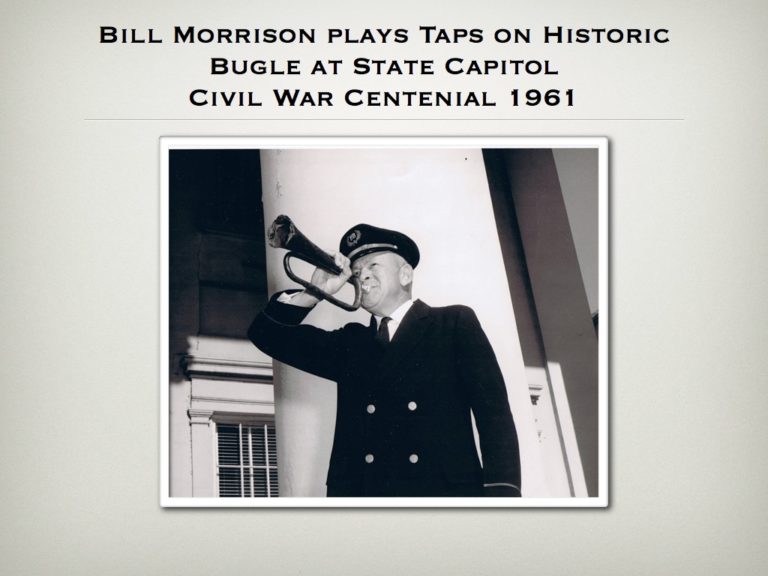
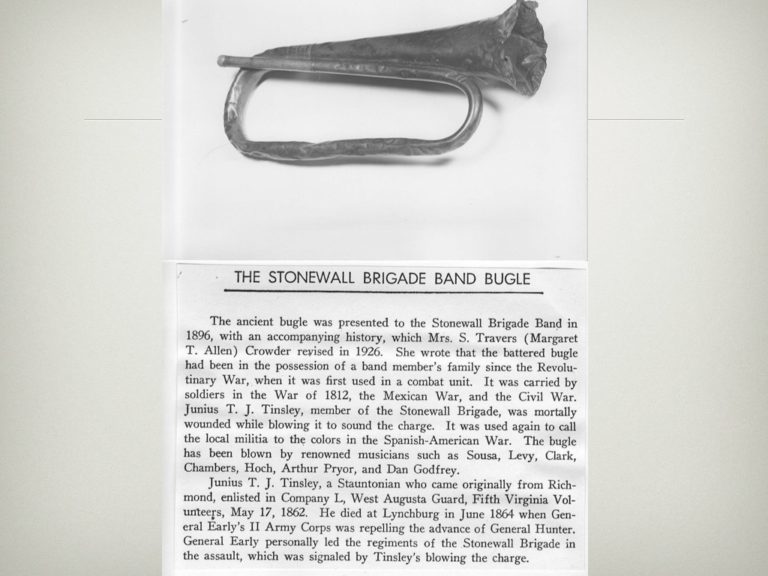
A crowning privilege came when the band was given the opportunity to sponsor a United States Marine Corps Band concert, under the direction of John Philip Sousa. The Marine Band played before a packed Opera House, now the Staunton City courthouse. After the concert, Dr. Sousa played several airs on the band's historic bugle, which was used in the Revolutionary War, War of 1812, the Mexican War, and the Civil War. During the Civil War Junius T. J. Tinsley, a soldier of the Stonewall Brigade was mortally wounded while blowing it to sound the charge. It was at this time that the bell was shot off the bugle. The historic bugle is still in the band's possession and has been played by such renowned musicians as Herbert L. Clarke—The Sousa Band's Cornet Soloist, Arthur Pryor—The Sousa Band's Trombone Soloist, and W. Paris Chambers—composer of the popular “March Religioso”.


Gypsy Hill Park
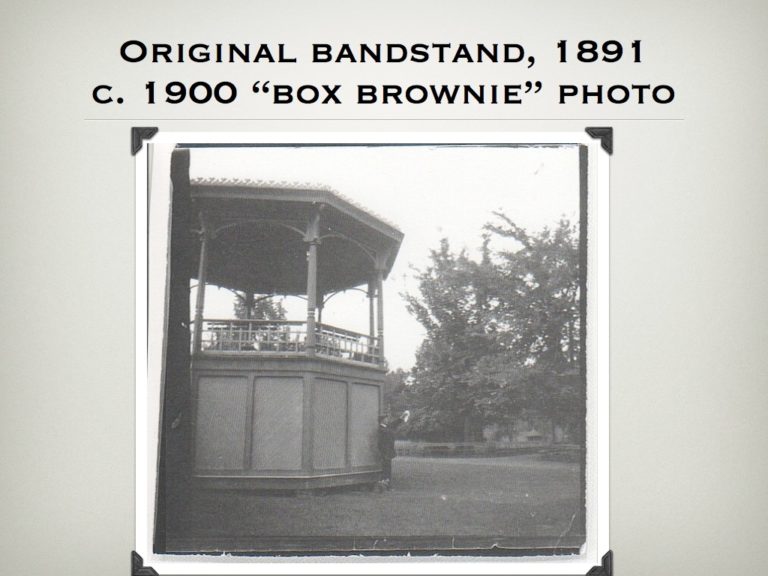
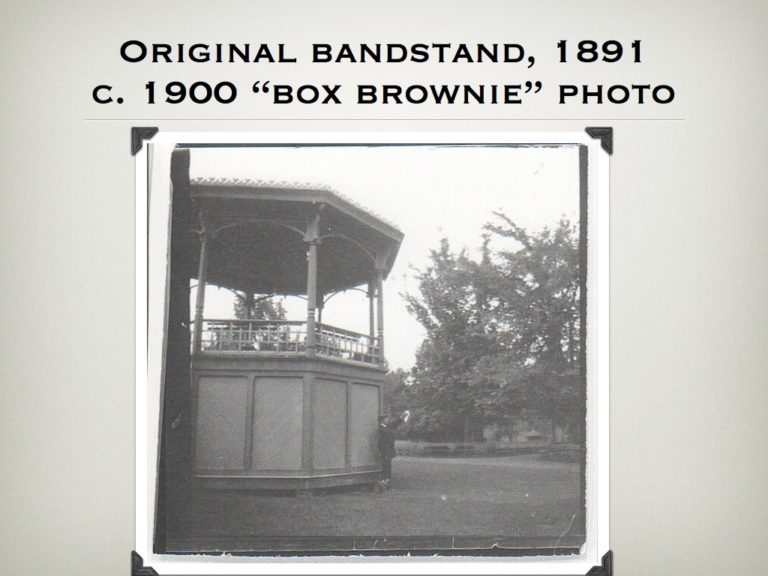
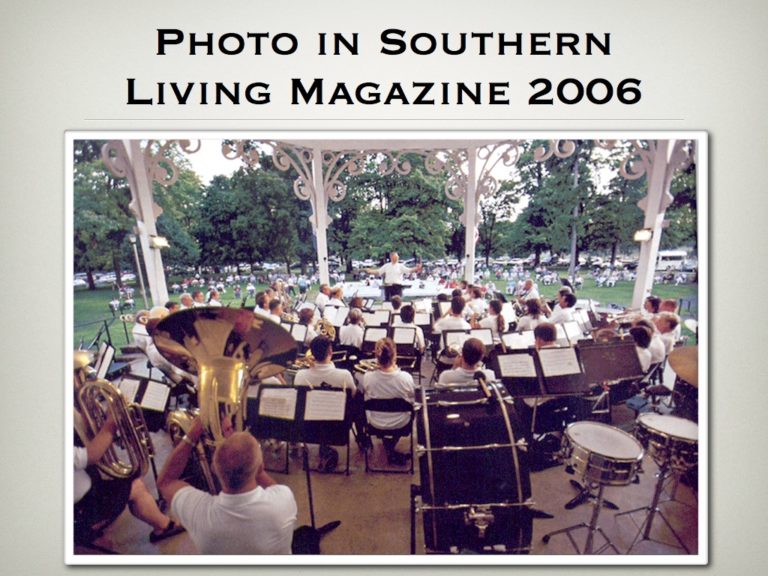
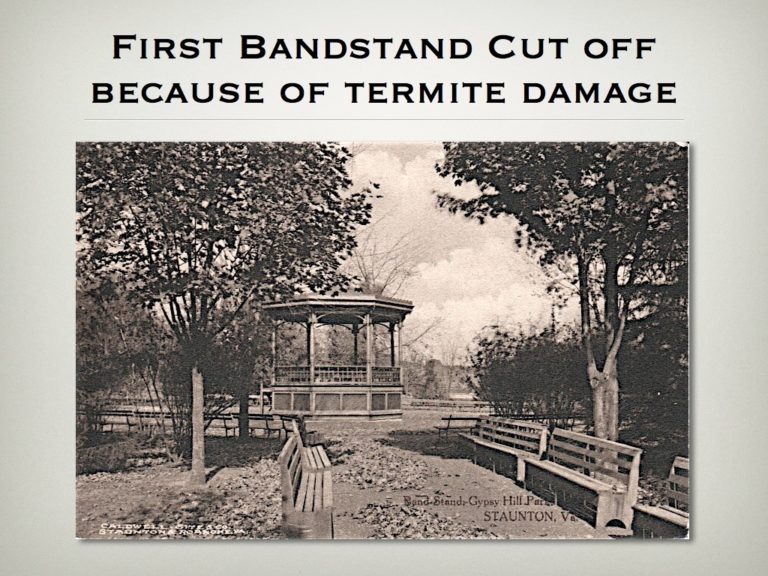
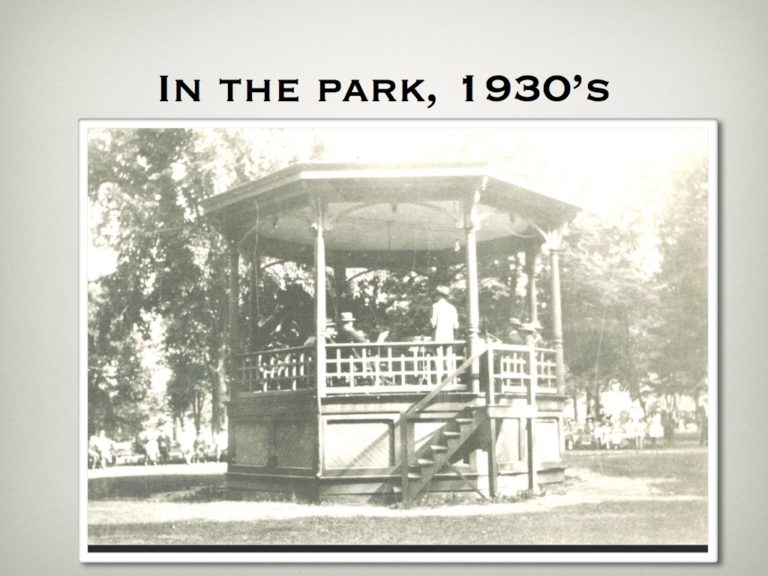
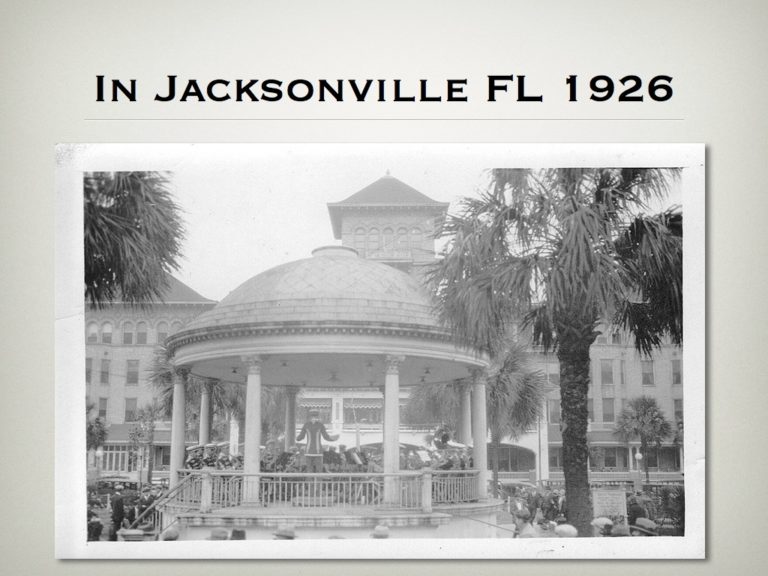
The city purchased thirty acres of the Donaghe farm in 1876 and purchased additional land to total eighty-five acres by 1889 when the name Gypsy Hill Park had been adopted. On Friday 1 November Arbor Day, 1889, the band played while fifteen hundred trees were planted in Gypsy Hill Park. Thus began the continuous series of concerts that has lasted to the present. The first bandstand was erected soon after and was a tall gazebo in the circle of trees south to southeast of the current bandstand.
Termites infested this first bandstand so the uprights were cut off and the bandstand lowered five feet.
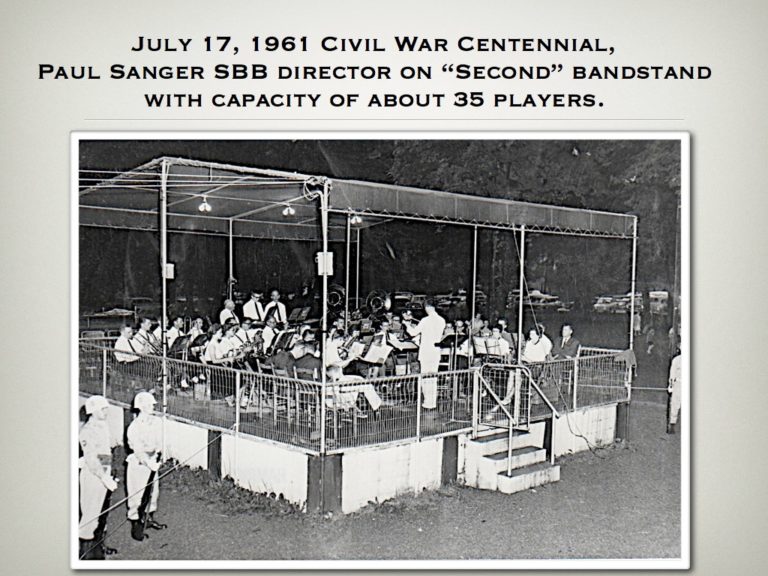
During World War II, the termites again took their toll and a temporary structure was placed several yards from the original site, facing west.Listeners could pull their cars onto the grass while children ran, danced, and marched around the bandstand as the band played.

The Stonewall Brigade Bandstand
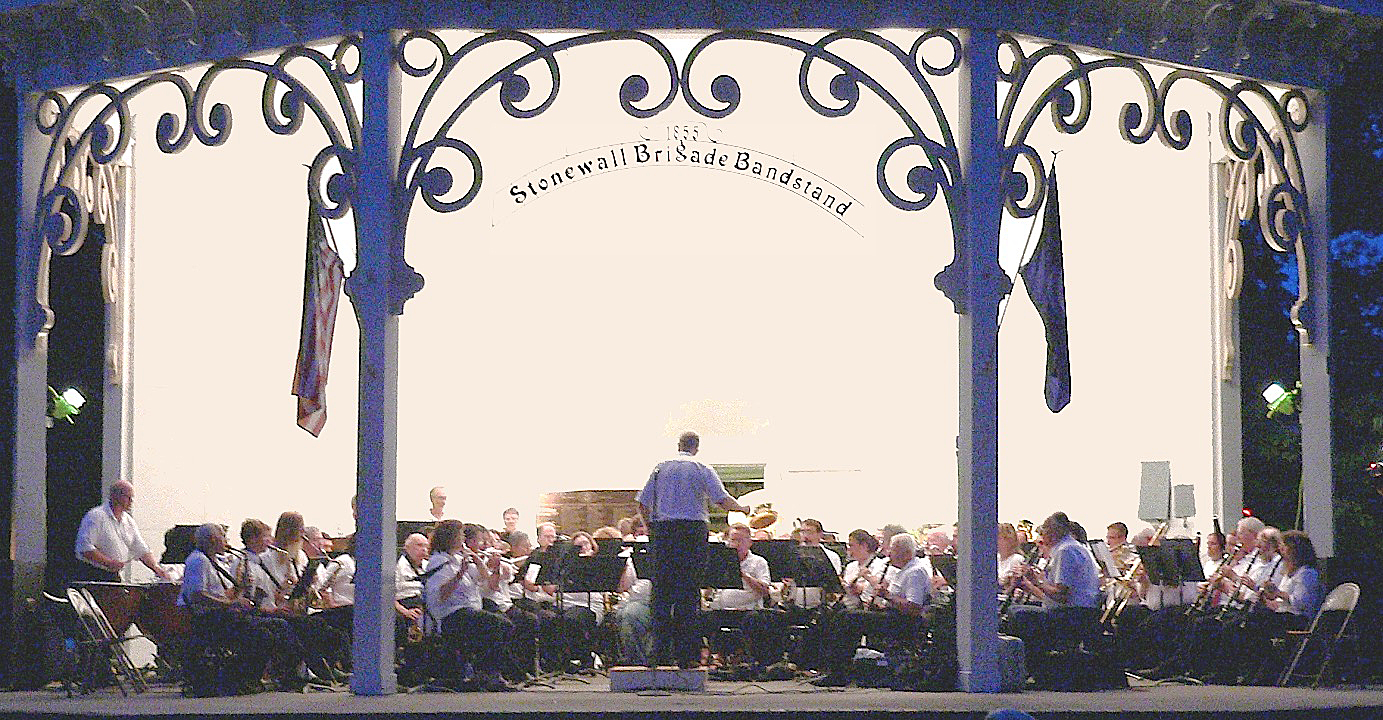
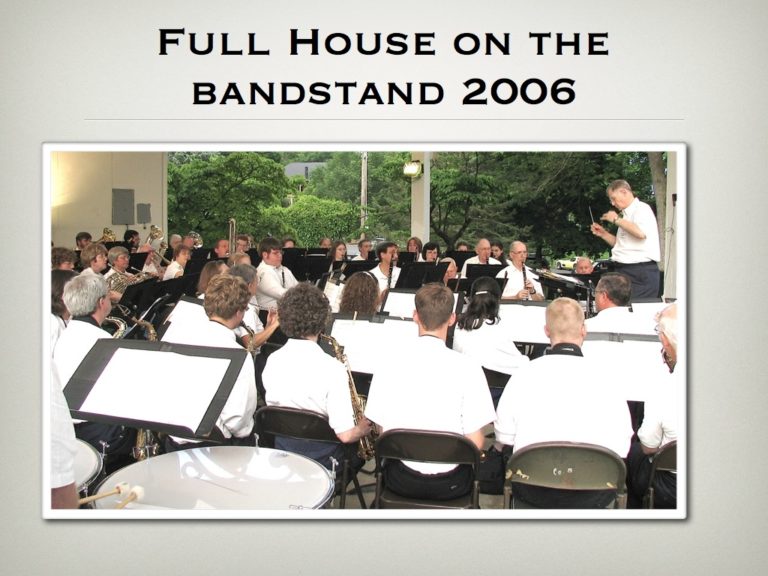
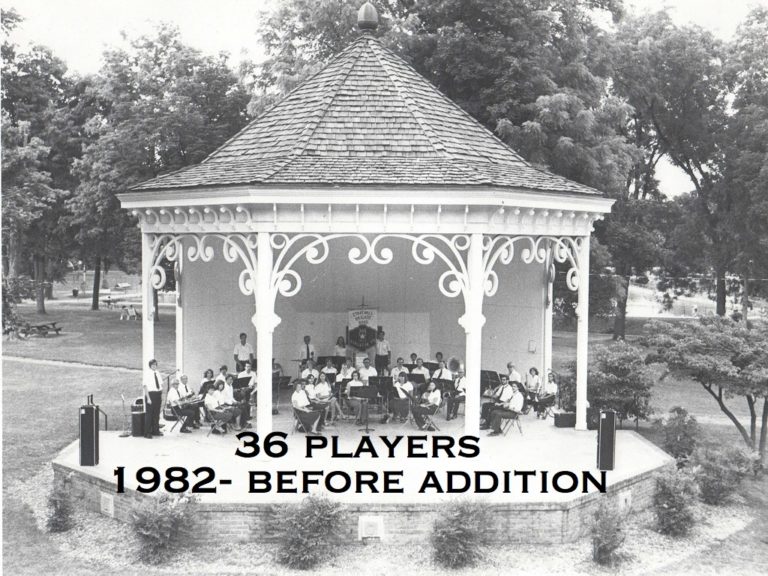
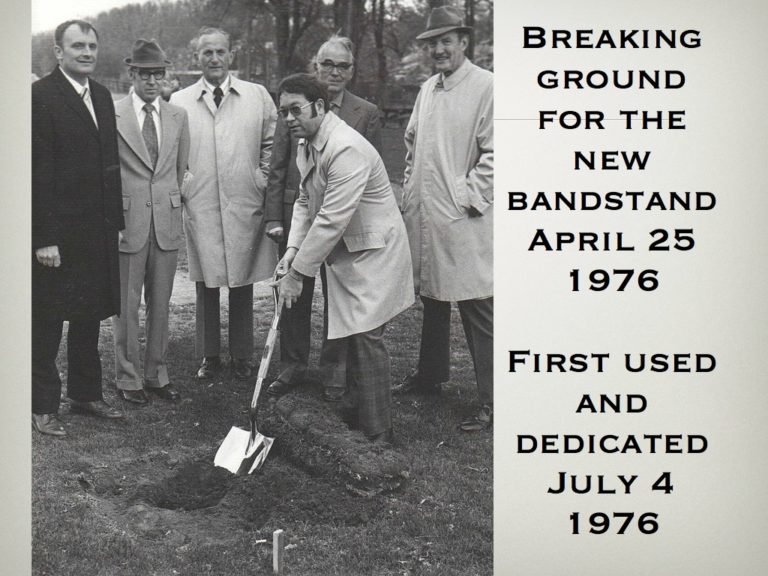
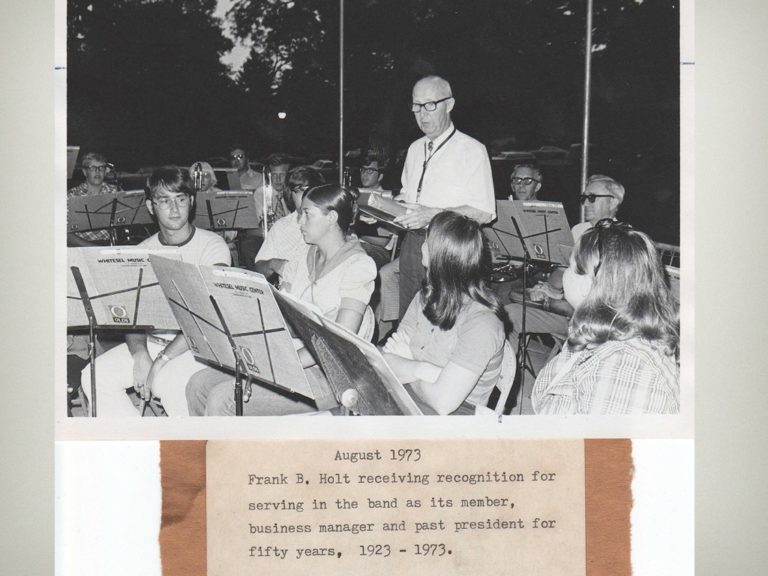
In February 1976 Frank B. Holt, a member of the band since 1923 and Past President of the Staunton Kiwanis Club asked the Kiwanis Club to raise funds to build a new bandstand. This won the immediate support of Mayor Frank Pancake, also a Kiwanian, and a committee was formed under the direction of Gifford Mabie and Kiwanis President Bruce Grover. Director Robert N. Moody drew up the acoustical specifications and dimensions for the new bandstand which was designed by architect Neal Goodloe, also a member of the Kiwanis. Contractor Roland Harshbarger coordinated the construction of the Gazebo bandstand without remuneration and much of the labor was donated by members of the Kiwanis and Jaycees. Much of the material that was not donated was sold to Kiwanians at cost, and a roofer, Fred H. Painter, donated his time to install the wood shingle roof. The dedication service for the new bandstand was Saturday, July 3, 1976 at 8 pm, featuring keynote speaker U.S. Senator Harry F. Byrd, Jr., and included a concert appropriate for celebrating the two hundredth birthday of the U.S.A. The City of Staunton provided an addition to the rear of the Gazebo in 1996, including restrooms, dressing rooms and storage for chairs and other equipment. The bandstand was rededicated on Flag Day, 2001 by proclamation of Mayor John Avoli in honor of the Stonewall Brigade detachment of the Virginia National Guard and the Stonewall Brigade Band and is now officially the Stonewall Brigade Bandstand.
The Oldest Continuous Community Band
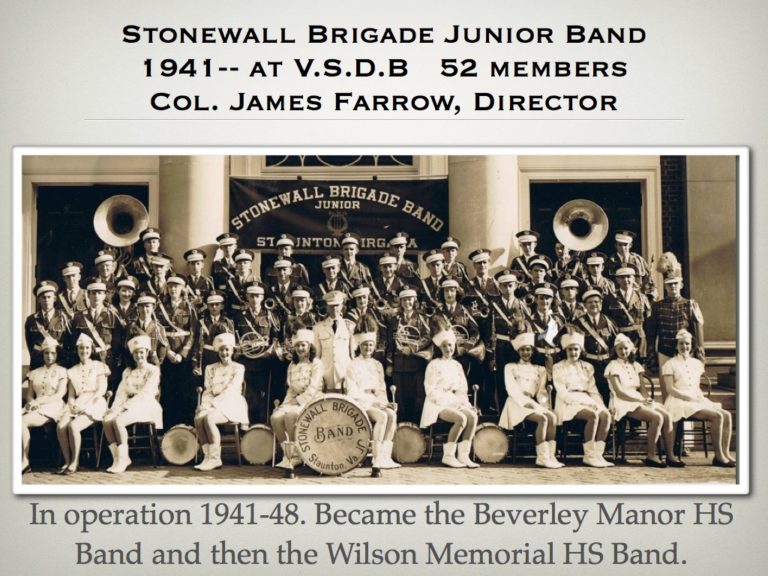
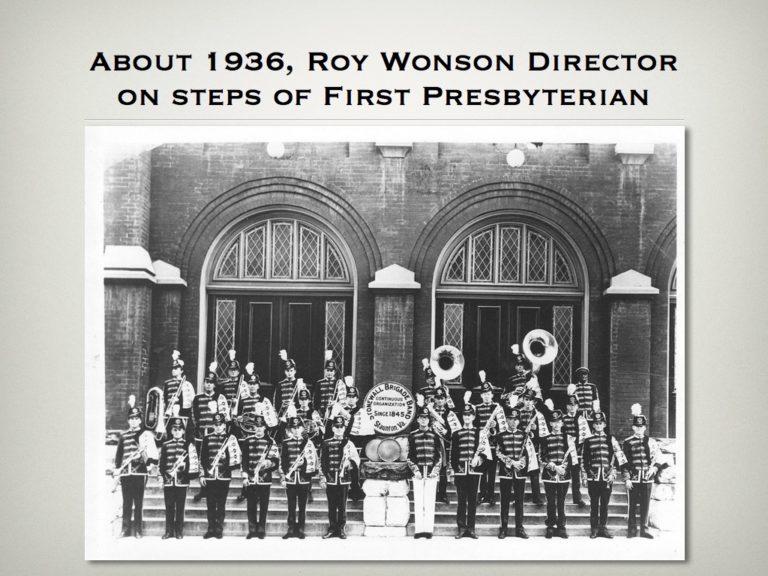
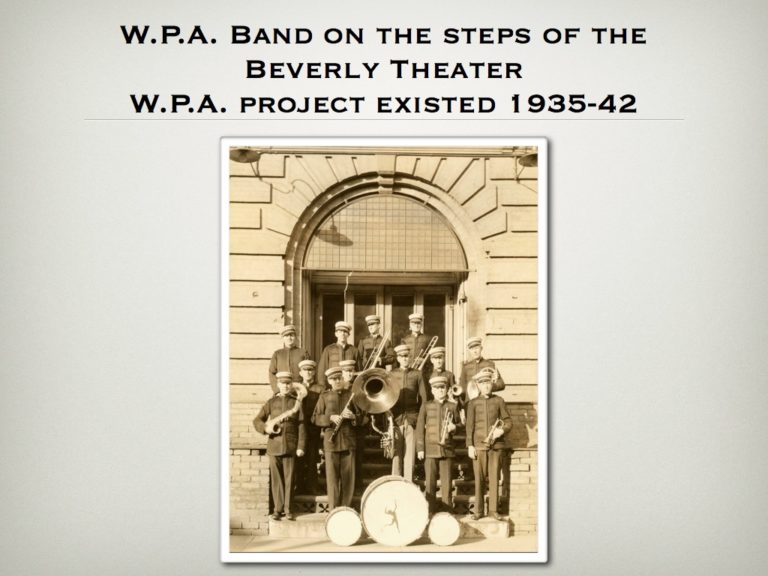
The Stonewall Brigade Band is the nation's oldest continuous community band sponsored by local government and funded, in part, by tax monies. While a number of community bands have their beginnings earlier than the Stonewall Brigade Band's 1855 founding, all of the other bands have gone out of existence at some time and then been reorganized. The Federal Music Project in Staunton under the Works Progress Administration during the 1930's employed a dozen bandsmen and is credited with helping the band survive the depression. The Stonewall Brigade Junior Band, in existence from 1941 to 1947 is credited with helping the band survive loss of members to the armed forces during World War II. The Junior band became the Beverley Manor High School Band in 1947, the first public school band in the area. The following year the high school students were all moved to Wilson Memorial High School, and the band there continues today as the offspring of The Stonewall Brigade Band.

The Band Today
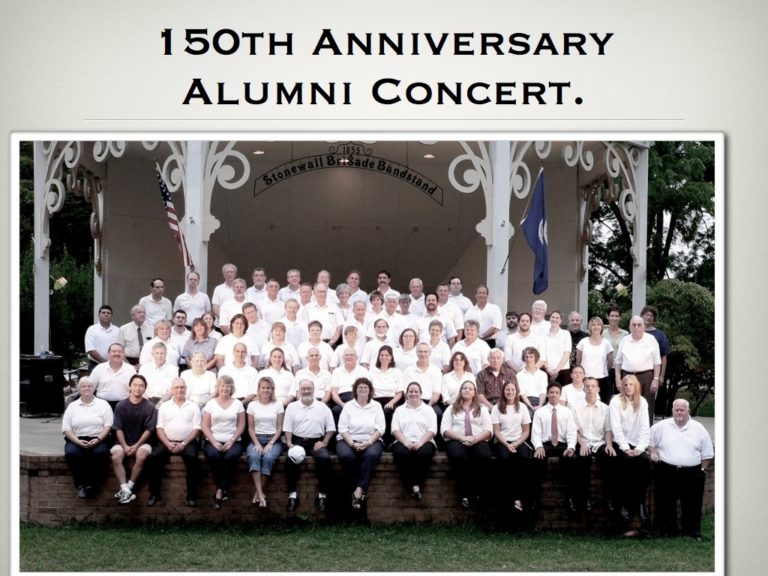
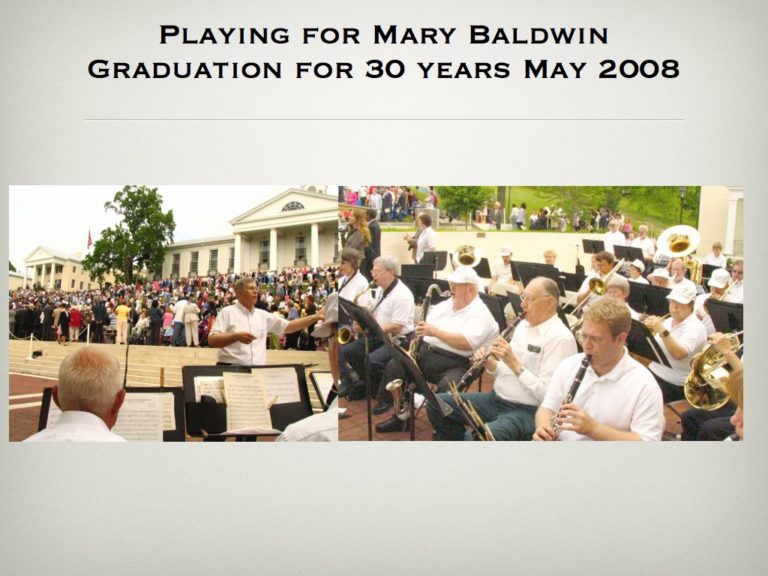
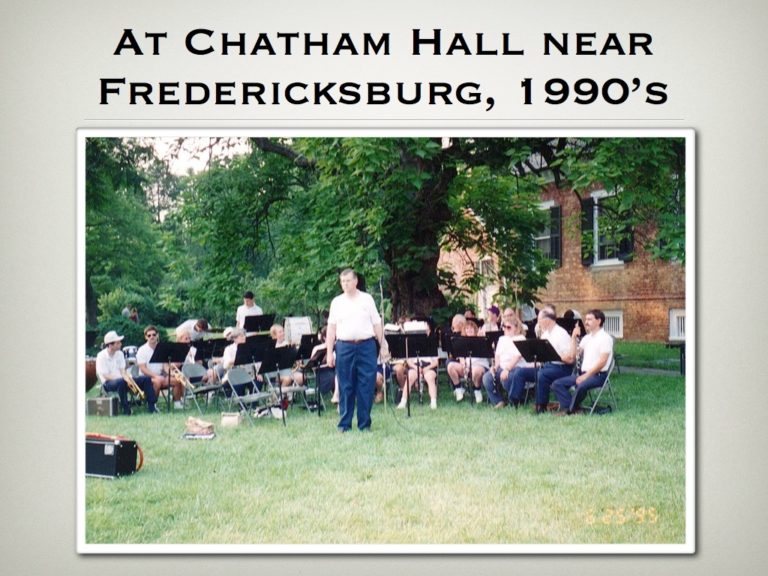
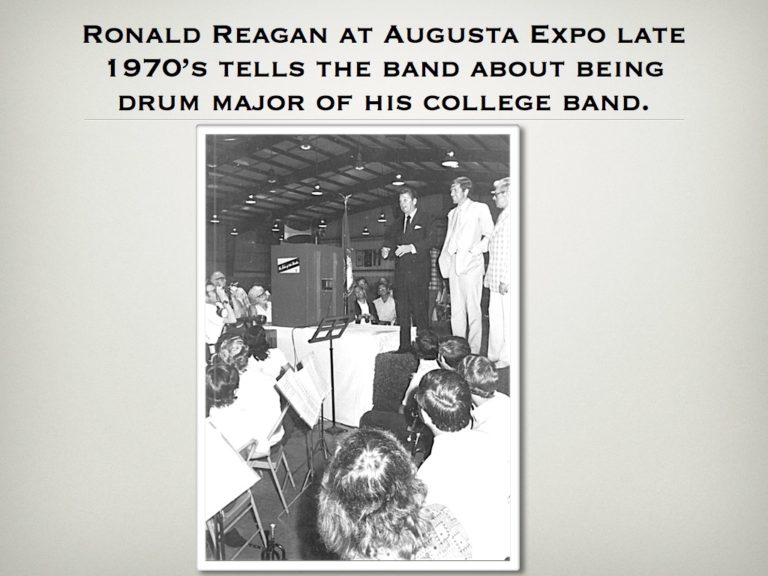
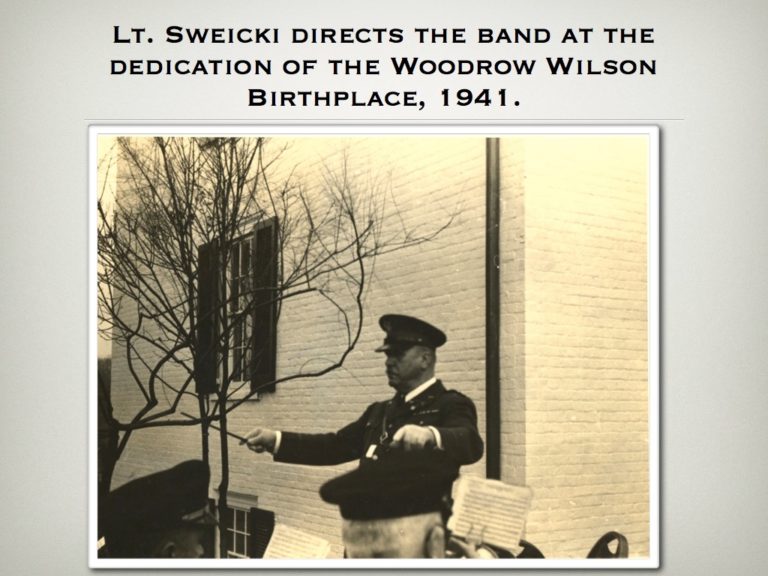
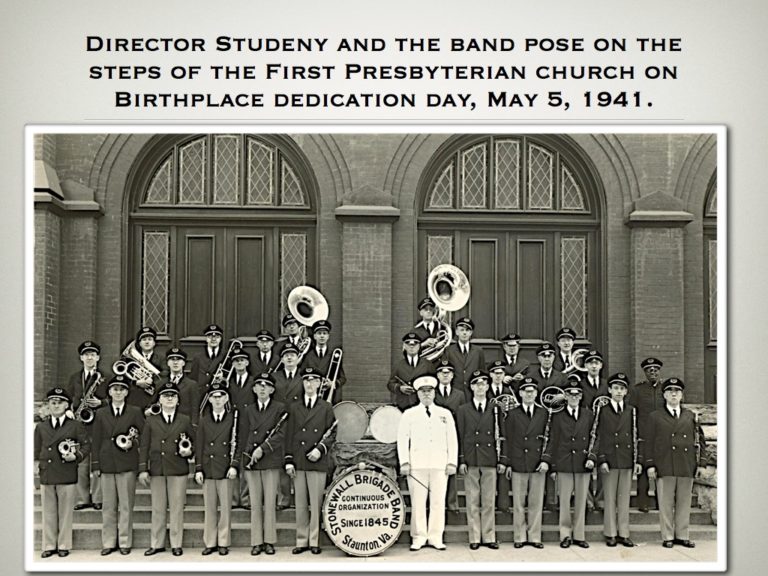
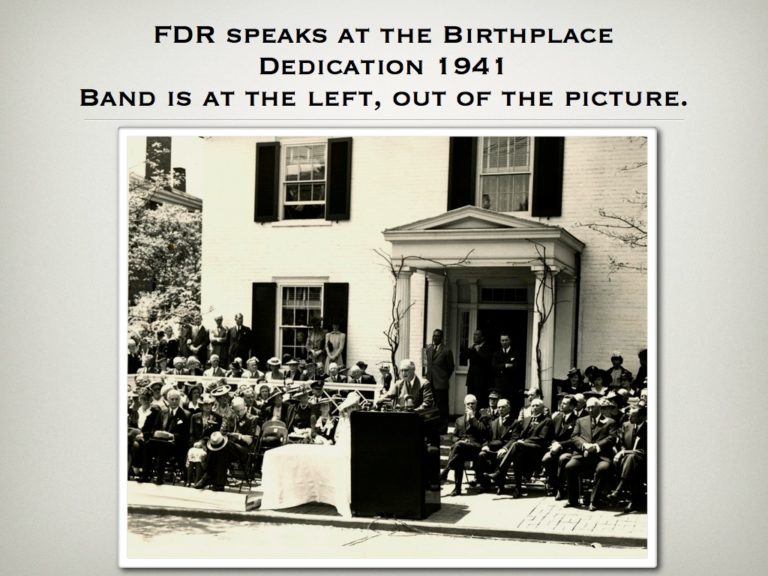
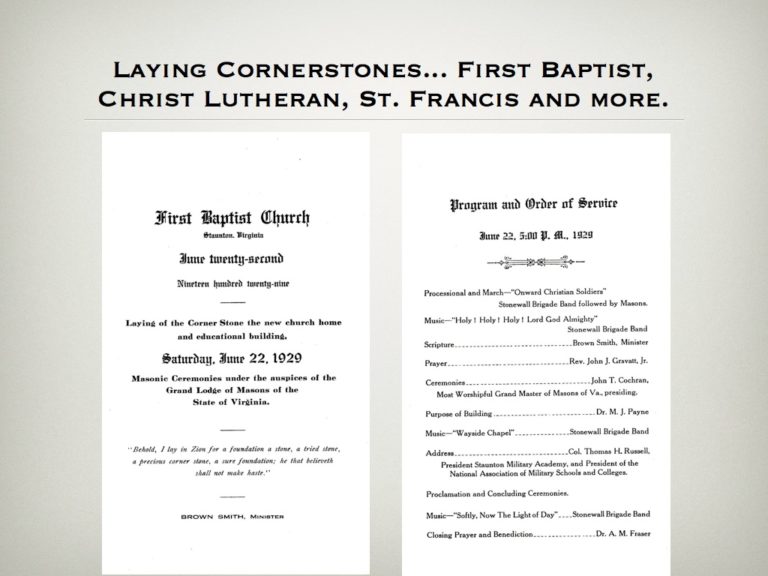
In recent years the band has furnished music for the dedication of numerous facilities, including the Woodrow Wilson Birthplace, the Augusta County flag, the Augusta County Library, The Museum of Frontier Culture, the Augusta County Government Center, McKee Bakery, and the Woodrow Wilson Museum. The band plays for many civic, historical, and patriotic occasions. Included among these are the visit to Augusta Expoland by Ronald Reagan in 1976, Christmas concerts to benefit the Valley Mission, a trip to Winchester to play for the United Daughters of the Confederacy memorial to General Turner Ashby, Memorial Day Services at the National Guard Armory, and annual Commencement ceremonies at Mary Baldwin College. In 1996 the band played for the 100th anniversary of the laying of the cornerstone at St. Francis Catholic Church, having played for the cornerstone laying 100 years before. In 2003 the band played for the 150th anniversary of Christ Lutheran Church, having played for the laying of the cornerstone in the late 1800's.
It also performed for the Virginia State Convention of the United Daughters of the Confederacy. In 2004, it performed at the Manassas National Battlefield Park in commemoration of the battle fought there in 1864 and at the Pamplin Foundation's "Celebration of America's Wars" in Petersburg, Virginia.
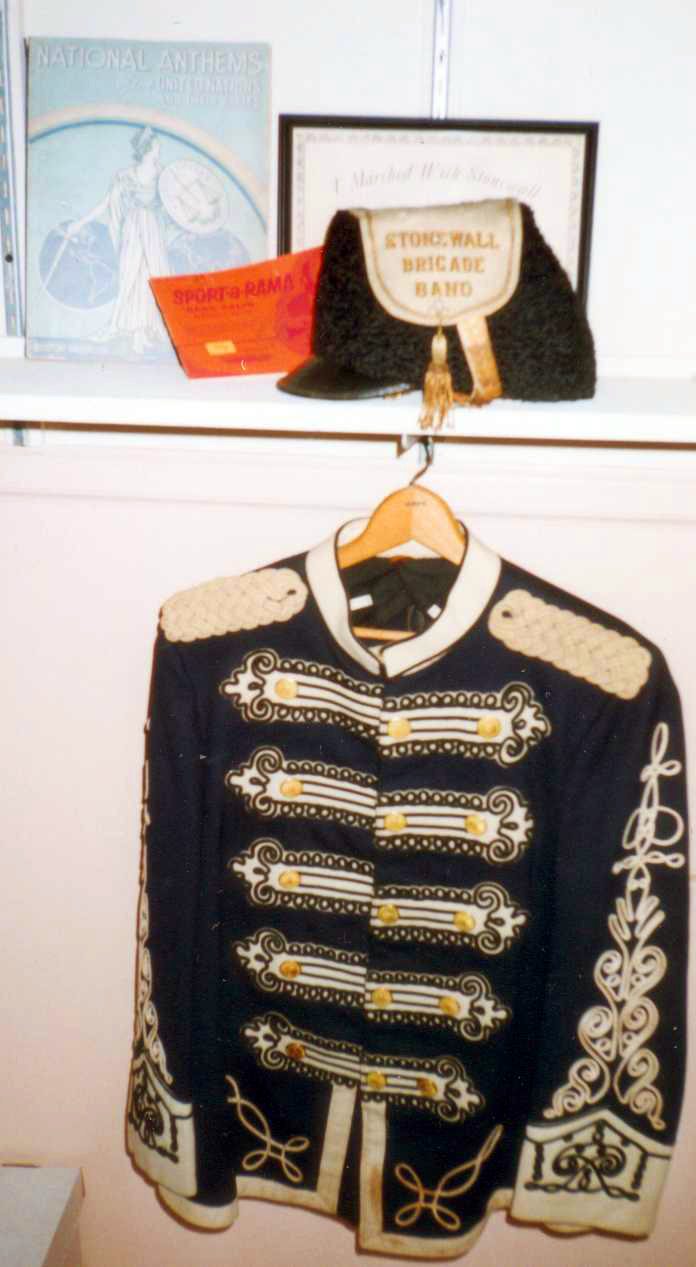
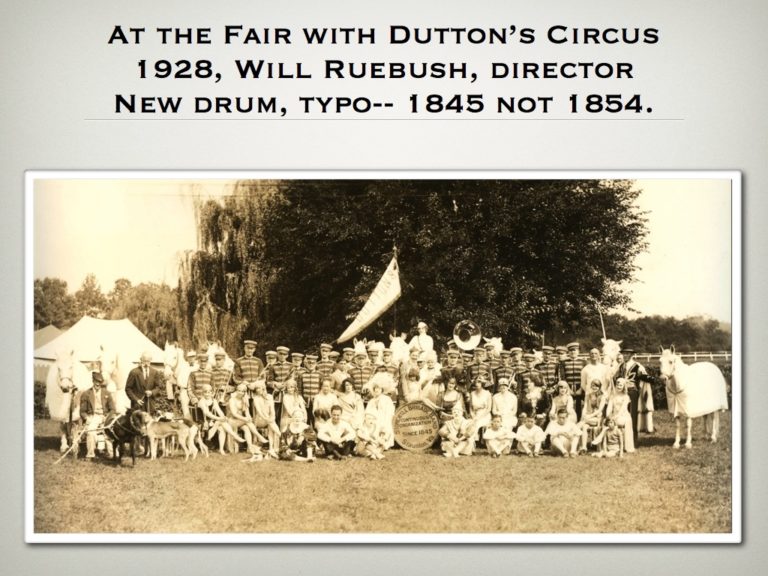
For impromptu engagements, the band uses its "Circus Band Book" sight-reading from a selection of popular tunes, waltzes, dances, and marches. Other small ensembles from within the band include a flute choir, a saxophone ensemble, and a brass ensemble, which performs in late 19th-century attire on period instruments.
Annual Schedule
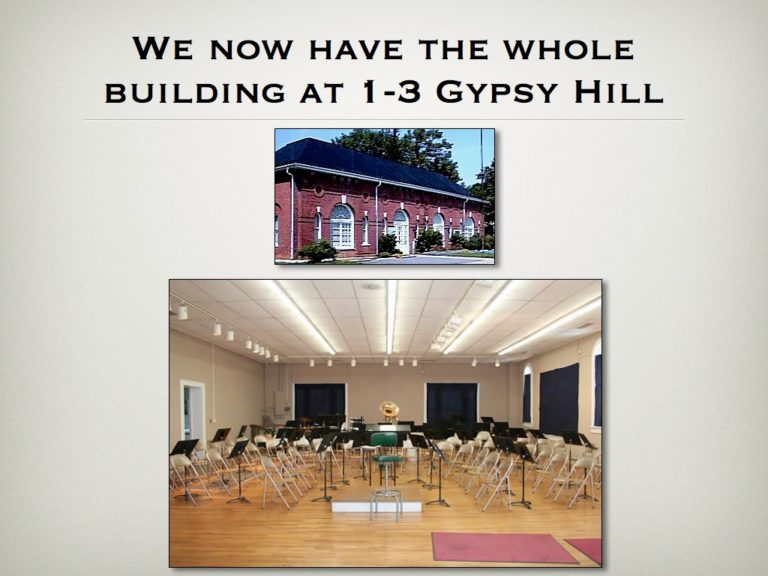
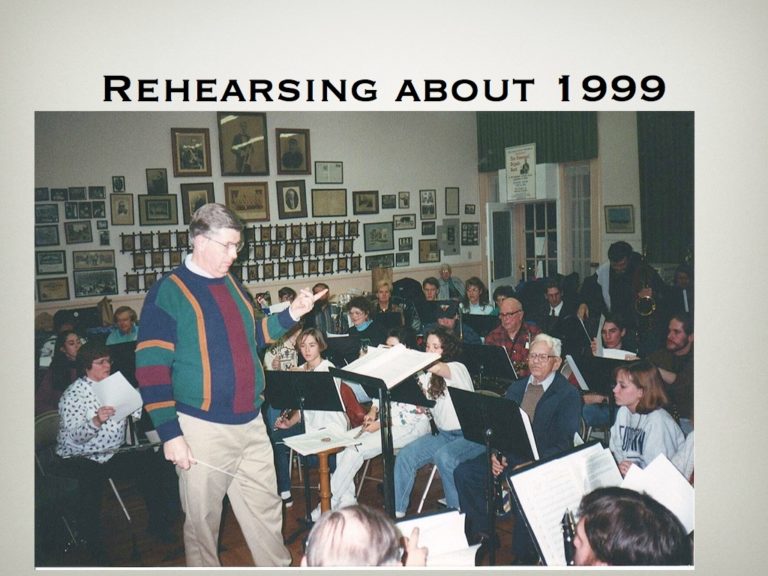
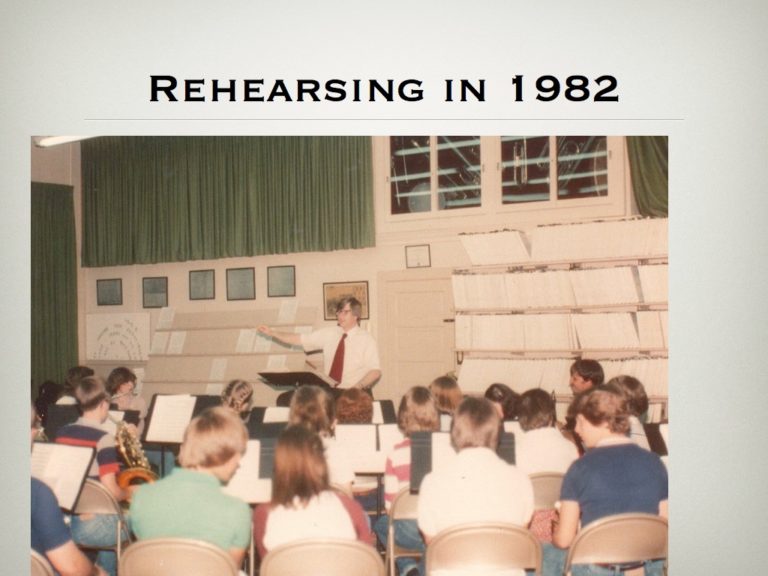
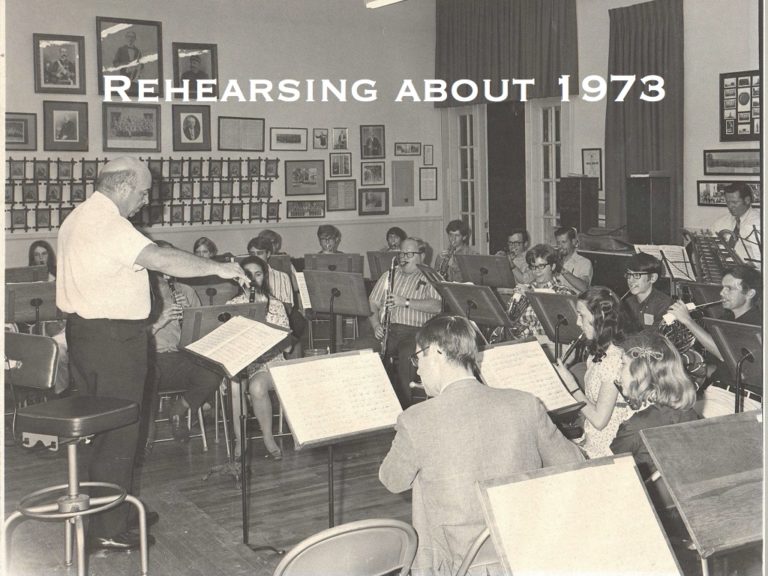
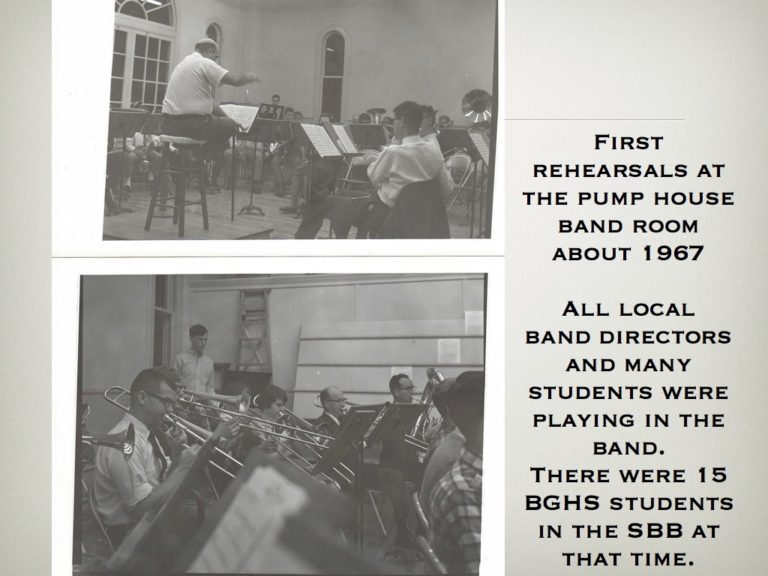
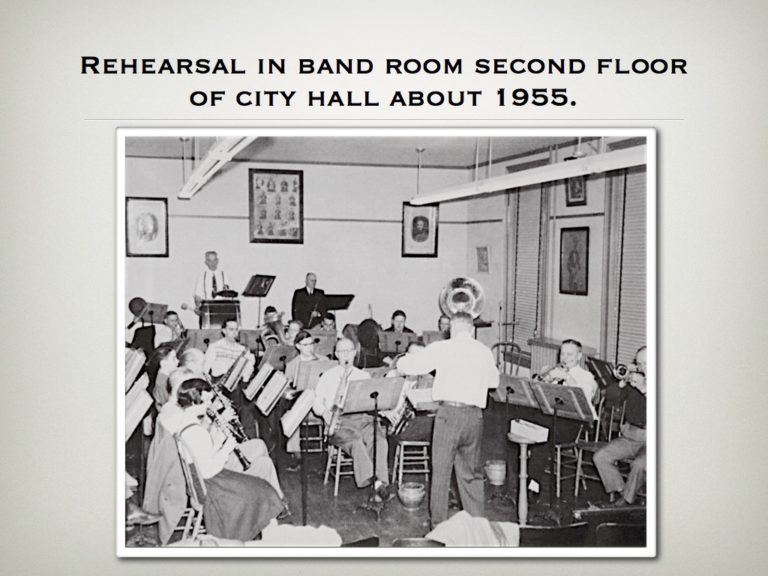
The band conducts its annual Fall-Winter-Spring series of rehearsals each Monday night, from 7:30 to 8:30 p.m. in the band room at the entrance to Gypsy Hill Park. Members learn new music and improve their performance skills in preparation for upcoming concerts. During these months the band reviews pieces needing added attention from the previous season, prepares a Christmas Concert, and sight-reading new compositions received "on approval" from the various publishers. The band members vote on the purchase of the music after playing through the selections. In mid-February the music committee and director select and program the music for the summer concert series and the remainder of the winter and spring rehearsals are spent on rehearsing each week's concert.
References
From The Stonewall Brigade Band, by Marshall Moore Brice. Condensed with additions by Frank Holt (1985) and Robert N. Moody (2003).
The Stonewall Brigade Band by Marshall Moore Brice (Professor of History, Mary Baldwin College, Staunton VA), McClure Printing Company, Inc., Verona, Virginia—Copyright 1967, Library of Congress Catalog Card Number: 67-30663.
(Copyright ownership - Stonewall Brigade Band, Inc. 2000 by gift of Elizabeth Brice Lendian).
The Stonewall Brigade Band by Marshall Moore Brice (out of print) is available for reference in the Staunton Public Library, and for loan from the Augusta County Public Library and the Massanutten Regional Library (Harrisonburg, Va.). Copies are available for purchase by special arrangement from the Stonewall Brigade Band, Inc. Address inquiries to: Treasurer, Stonewall Brigade Band, Inc., 3 Gypsy Hill Park, Staunton, VA. 24401.

for UVA’s “Valley of the Shadow” project, which offers an extensive history of the Shenandoah Valley and the Civil War. There are several references to the Stonewall Brigade Band; consult the site map and then do a page search for band, or run a Google search for “Valley of the Shadow Stonewall Brigade Band.”

Museum
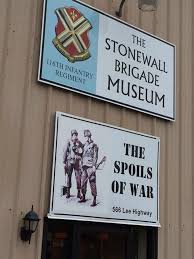
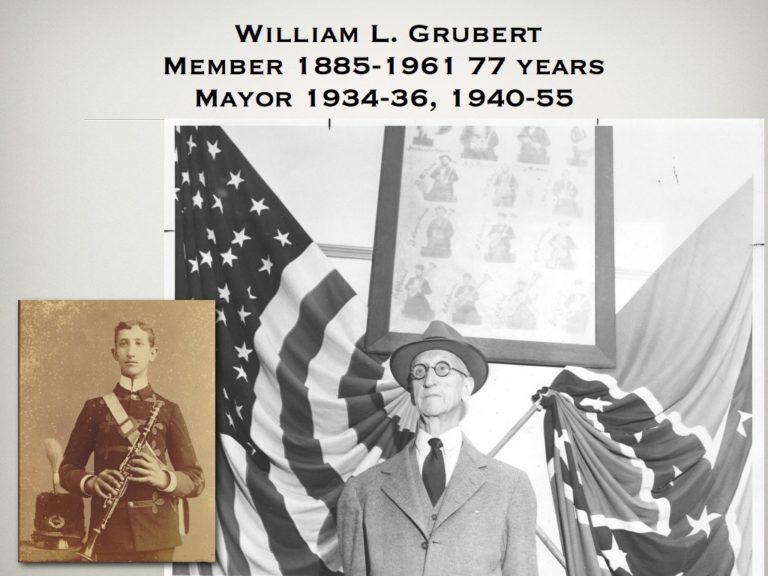
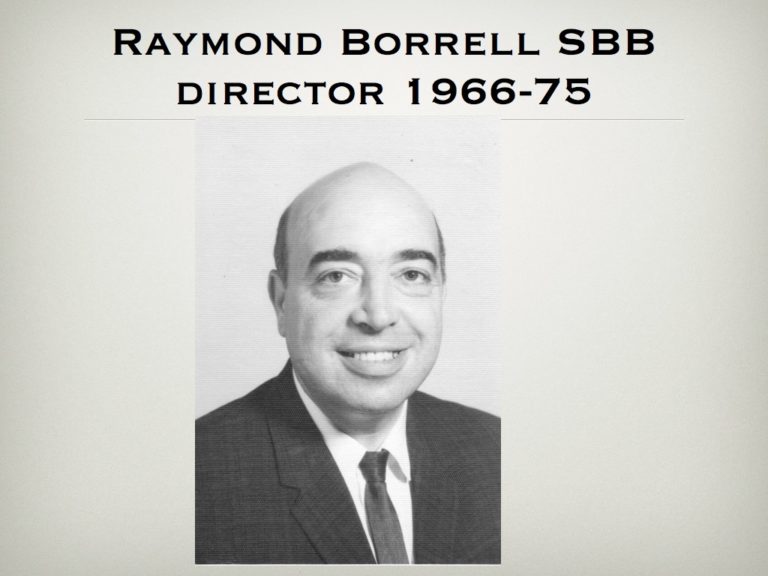
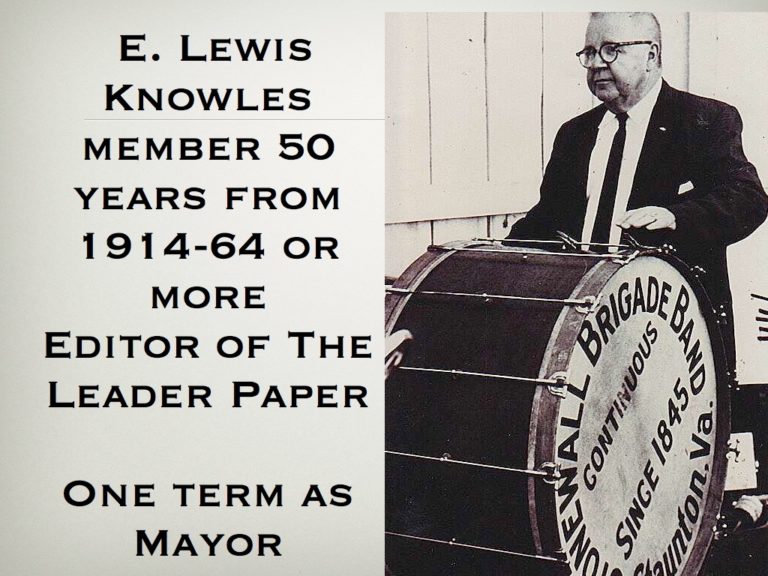
We are excited that our bandroom and museum will undergo some long needed repairs and upgrades. We will still have our historic instruments and much of our exhibit on display by appointment. To arrange an appointment, please contact one of the board members.







Bylaws
BYLAWS OF THE STONEWALL BRIGADE BAND, INC.
I: Name
The name of the corporation shall be the Stonewall Brigade Band, Inc. The corporation was formed by a certificate of incorporation dated September 1, 1987, amended June 27, 1988.
II: Purpose
This corporation was formed for and continues to serve the following purposes: (1) to offer high quality music programs and performances to benefit the citizens and the community; (2) to foster better and new relationships among musicians; (3) to preserve the musical heritage of the Shenandoah Valley; (4) to continue in perpetuity the long history of the Stonewall Brigade Band; (5) to further promote charitable and educational programs, particularly in the field of music; (6) to receive by gift, devise, bequest or otherwise, personal or real property, and to hold, sell, invest, reinvest, manage, use, disburse and distribute, and apply the income and/or principal of the same for charitable, educational, civic and philanthropic uses; and (7) to do any and all things necessary to accomplish its purposes.
III: Governing Law
-
State law: The Corporation is a non-stock Virginia corporation as defined in the Virginia Non-stock Corporation Act, Title 13.1, Chapter 10 of the Code of Virginia, 1950, as amended and shall be governed by the laws of the Commonwealth of Virginia.
-
Federal law: The corporation is a non-profit corporation with a tax-exempt status pursuant to Articles 501(c) (3) and 509 (a) (1), (2) or (3) of the Internal Revenue Code of 1954, as amended. As such, nothing herein shall authorize this corporation directly or indirectly, to engage in or include among its purposes, any activities which would prevent or cause loss of tax exempt status of this corporation or any activity of this corporation. No substantial part of the activities of this corporation shall be for the purpose of carrying on propaganda, or otherwise attempting to influence legislation. None of the activities of this corporation shall consist of participating in, or intervening in (including the publishing or distributing of statements), any political campaign on behalf of any candidate for public office. No part of the net earnings of this corporation shall inure to the benefit of any private shareholder or any individual. The property of this corporation is irrevocably dedicated to charitable purposes and upon liquidation, dissolution or abandonment of the owner, after providing for the debts and obligations thereof, the remaining assets will not inure to the benefit of any private person but shall be distributed to a non-profit fund, foundation or corporation which is organized and operated exclusively for charitable purposes and which has established its tax-exempt status under Articles 501 (c) (3) and 509 (a) (1), (2) or (3) of the Internal Revenue Code of 1954.
IV: Duration
The period during which this corporation is to continue as a corporation is perpetual.
V: Service Area
This corporation shall serve primarily the following geographic areas: Augusta County, the City of Staunton and the City of Waynesboro, but has provided and will provide charitable and educational programs and performances where requested or deemed appropriate.
VI: Membership
There shall be three classes of membership of the corporation:
-
Full member: Full members are those who have been elected as such by the membership. Each full member is entitled to one (1) vote. To be eligible for full membership, a prospective member must first be an associate member for six (6) months, during which time the prospective member shall have attended at least fifty percent (50%) of the band’s functions (rehearsals, concerts, etc.), shall be of good character, and must have demonstrated interest in and cooperation with the organization’s activities and proficiency on an instrument.
Full members shall be elected for life, but only active full members shall be entitled to vote on matters coming before the membership. Any full member who has failed to attend at least one rehearsal during the three (3) months preceding the taking of any vote shall be deemed to be inactive, and shall not be entitled to vote unless, prior to the date of the vote, such person has notified the membership committee in writing of his or her intention to participate actively in rehearsals during the following three-month period. All other full members shall be deemed to be “active full members” unless they have resigned their membership or their membership has been otherwise terminated.
-
Associate member: Associate members are those who have been invited by a full member, after consultation with the music director, to participate in rehearsals and other functions of the band.
-
Honorary member: Honorary membership may be conferred by the Board of Directors upon those persons who have, through musicianship or other outstanding service in former years, made a substantial contribution to the band.
VII: Board of Directors
-
Management. The management of the corporation shall be vested in a Board of Directors consisting of at least seven (7) persons, a majority of whom shall be full members. The Board shall have the authority to establish such policies, rules and regulations as shall be necessary for the efficient operation of this Corporation.
-
Election of Directors. Directors shall be elected by a majority of a quorum of the members at a regular or special meeting of the members to be held prior to December 31 of each year and shall serve one (1) one-year term. The Nominating Committee, to be appointed by the President before October 31, shall nominate eligible candidates for election to the Board of Directors and shall submit its written report and recommendations to the Board of Directors, within 30 days of their appointment. In addition to those candidates named by the Nominating Committee, any voting member of the corporation may nominate additional candidates from the floor at a regular or special meeting of the members.
-
All vacancies on the Board of Directors may be filled by vote of a majority of a quorum of the members at any regular or special meeting of the members, from a slate of nominees proposed by the Board of Directors.
VIII: Officers and Staff
VIII-1 – Officers and Their Duties
-
Prior to January 1 of each year, the directors shall elect the officers of this corporation, all of whom shall be members of the Board of Directors. All officers shall hold offices for one year, beginning January 1, or until their successors are elected. Any office vacated prior to the next annual meeting shall be filled by a member of the board elected by a quorum of the members of the Board of Directors.
-
The following officers shall be elected by the Board of Directors: President; Vice President; Secretary; Treasurer; and Business Manager.
-
The President, or in the absence thereof, the Vice President, or in the absence of the Vice-president, the Business Manager, shall preside at all meetings of members and of the Board of Directors and shall perform the duties usually devolving upon a presiding officer.
The President shall appoint a nominating committee of three (3) members at the first meeting in October of each and every year.
With the exception of the nominating committee, the President shall be an ex-officio member of all committees.
-
Vice-President. It shall be the duty of the Vice-President to render the President such assistance as may be required, and to perform the duties of President in his/her absence. In the event both the President and the Vice-President are absent, the presiding officer shall be the Business Manager.
-
Treasurer. The Treasurer shall have the custody of all funds and securities of the corporation and shall assure full and accurate accounts of receipts and disbursements including deposit of all monies and other valuable effects in the name and to the credit of the corporation in such depositories as may be designated by the Board of Directors. The Treasurer shall disburse the funds of the corporation as may be ordered by the Board of Directors, taking proper vouchers for such disbursements, and shall render to the Board of Directors at the regular meetings of the Board, or whenever necessary, an account of all transactions and of the financial condition of the corporation. Such accounting shall be made available to the membership within ten (10) days thereafter.
-
Secretary. It shall be the duty of the Secretary to maintain accurate, permanent written recordings of all business proceedings and to post or publish these recordings for the benefit of the membership within ten (10) days thereafter. The Secretary shall be a permanent member of any membership committee.
-
Business Manager. It shall be the duty of the Business Manager to conduct negotiations for engagements and travel; to conduct the public relations affairs of the Stonewall Brigade Band, Inc.; and to perform such duties as may be required or assigned to him/herpertaining to the normal affairs of any other or similar business organization and to preside over meetings as provided herein above.
VIII-2 – Staff and Their Duties
The following staff positions are to be appointed by the Board of Directors and subject to the control of the Board of Directors in the following duties:
-
Music Director. The Music Director shall have absolute control of the presentation of all music to be played by the Stonewall Brigade Band on all occasions. The Music Director shall select and enlist Assistant Music Directors to perform the duties of Music Director during his absence.
-
Librarian. The Librarian shall be responsible for all Stonewall Brigade Band, Inc. music and its distribution and use on all occasions and must see that it is kept in good condition.
IX: Committees
-
The Standing Committees shall be Music, Nominating, and Facilities committees appointed in accordance with the provisions contained in Paragraph B herein below. The committees shall carry out such purposes as directed by the Board of Directors.
-
The President shall appoint members to serve on standing committees. Subject to the approval of the Board of Directors, the President may appoint any other special committee or committees that may be necessary and proper to carry out the purposes of the corporation.
X: Meetings
-
The annual meeting of the members of this corporation shall be held at such places and on such day and hour as the Board of Directors may determine. Special meetings may be called at any time by the President or by the written request of two members of the Board of Directors.
At any meeting of the membership a quorum shall consist of the presence of both thirty percent (30%) of those persons qualifying at the time of the meeting as active full members of the corporation and a majority of those persons then serving as directors of the corporation. A simple majority of those full members present at such meeting is required to pass any action.
-
Notice of any meeting of the members of this corporation, annual or special, stating the time and place of the meeting shall be made to all members by such means as the Board of Directors may decide, not less than ten nor more than forty days before the meeting.
-
Regular meetings of the Board of Directors of this corporation shall be held bi-monthly. A Special Meeting of the Board of Directors may be called at any time by the President, or in his or her absence, the Vice-President, or upon the request of two members of the Board of Directors.
Notice of regular meetings of the Board of Directors shall be provided to the members of the corporation in person, by U.S. Mail, or by electronic mail as soon as is practicable, not less than two (2) days nor more than thirty-five (35) days prior to the meeting.
Members of the corporation may attend regular meetings of the Board of Directors but shall have no vote. Members wishing to speak must make such request, in writing, to the President not less than two (2) days or more than thirty-five (35) days prior to the meeting and may be granted a reasonable length of time for such address.
-
Notice of all meetings of the Board of Directors shall be provided to the members of the board in person, by U.S. Mail, or by electronic mail as soon as is practicable, not less than two (2) days nor more than thirty-five (35) days prior to the meeting. Notice may be waived.
-
At any regular or special meeting of the Board of Directors, a quorum for the transaction of business shall be one-half of the total number of directors existing at the time of the meeting.
-
In situations where immediate action on the part of the Board of Directors is necessary in order to preserve the viability, strength, and integrity of the corporation, and it is not possible to assemble a quorum of the Board of Directors before a vote must be taken, the Board of Directors may vote on an action by electronic mail or by telephone.